
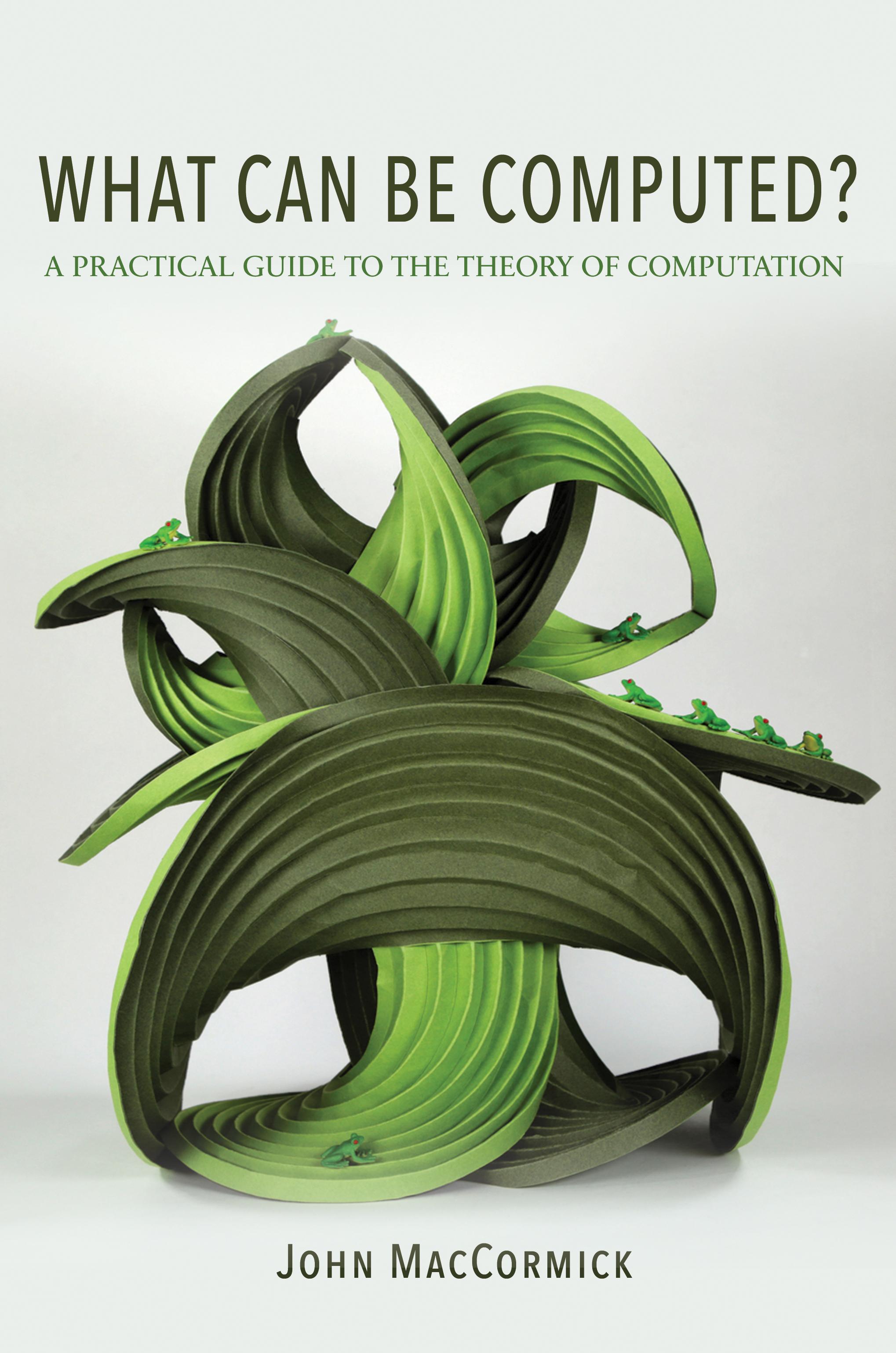
An accessible and rigorous textbook for introducing undergraduates to computer science theory
What Can Be Computed? is a uniquely accessible yet rigorous introduction to the most profound ideas at the heart of computer science. Crafted specifically for undergraduates who are studying the subject for the first time, and requiring minimal prerequisites, the book focuses on the essential fundamentals of computer science theory and features a practical approach that uses real computer programs (Python and Java) and encourages active experimentation. It is also ideal for self-study and reference.
The book covers the standard topics in the theory of computation, including Turing machines and finite automata, universal computation, nondeterminism, Turing and Karp reductions, undecidability, time-complexity classes such as P and NP, and NP-completeness, including the Cook-Levin Theorem. But the book also provides a broader view of computer science and its historical development, with discussions of Turing's original 1936 computing machines, the connections between undecidability and Gödel's incompleteness theorem, and Karp's famous set of twenty-one NP-complete problems.
Throughout, the book recasts traditional computer science concepts by considering how computer programs are used to solve real problems. Standard theorems are stated and proven with full mathematical rigor, but motivation and understanding are enhanced by considering concrete implementations. The book's examples and other content allow readers to view demonstrations of—and to experiment with—a wide selection of the topics it covers. The result is an ideal text for an introduction to the theory of computation.
- An accessible and rigorous introduction to the essential fundamentals of computer science theory, written specifically for undergraduates taking introduction to the theory of computation
- Features a practical, interactive approach using real computer programs (Python in the text, with forthcoming Java alternatives online) to enhance motivation and understanding
- Gives equal emphasis to computability and complexity
- Includes special topics that demonstrate the profound nature of key ideas in the theory of computation
- Lecture slides and Python programs are available at whatcanbecomputed.com
Zahle einfach mit Karte, Klarna, Apple Pay oder Google Pay. Nicht zufrieden? Du hast immer ein 14-tägiges Widerrufsrecht. Lies mehr in unseren AGB. Hast du Fragen, schreib uns eine E-Mail an hello@memmo.org.
Memmo macht das Lernen einfacher – wo auch immer du bist. Bei uns findest du deine Kursbücher und smarte Lerntools an einem Ort: Zusammenfassungen, Quizzes, Podcasts und Lernkarten. Und Ted, dein Lernbuddy, beantwortet alles, was du wissen möchtest. Über 50.000 Studierende lernen bereits hier – gemacht, damit du schneller lernst und weniger Stress hast.