
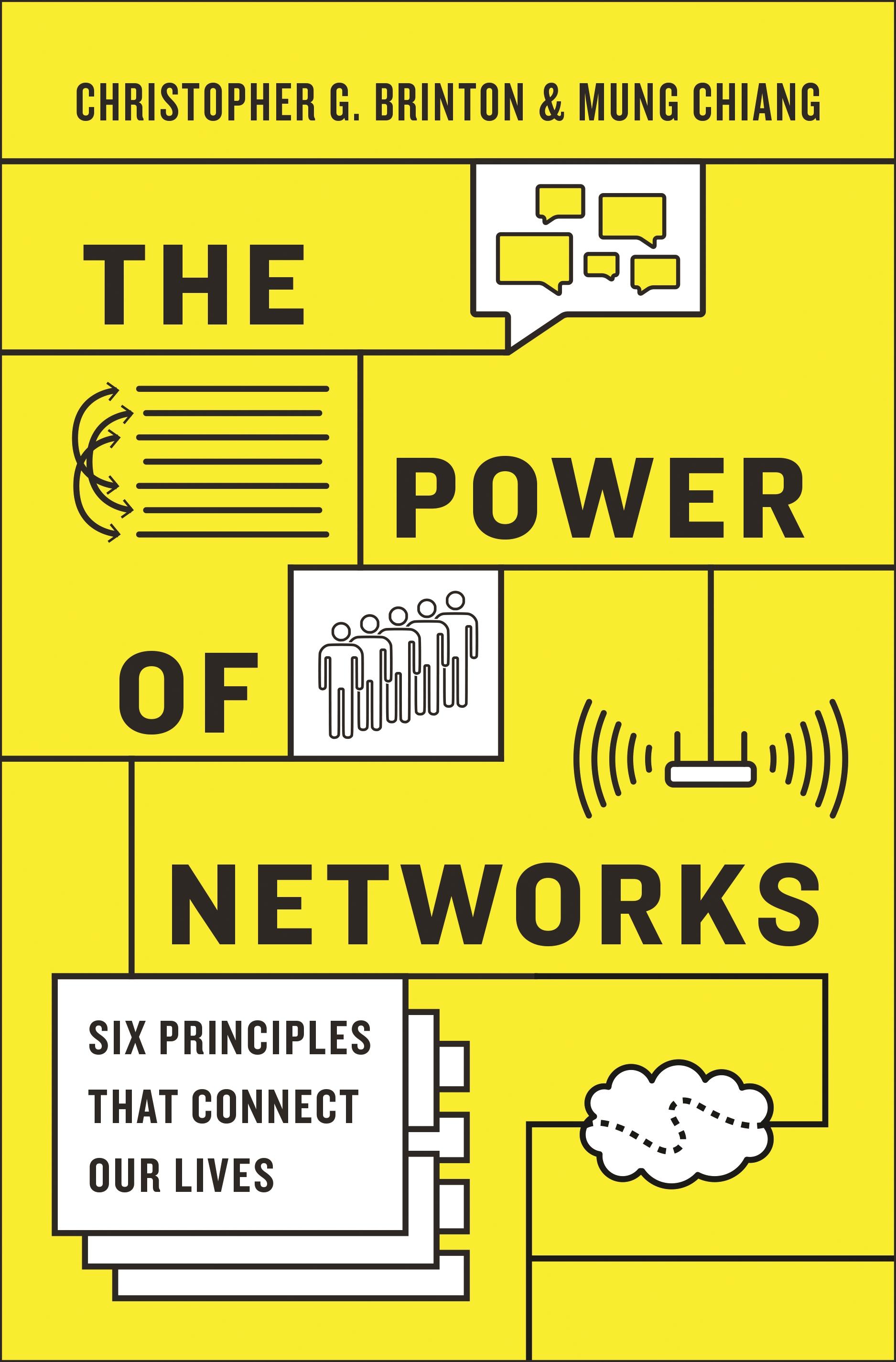
An accessible illustrated introducton to the networks we use every day, from Facebook and Google to WiFi and the Internet
What makes WiFi faster at home than at a coffee shop? How does Google order search results? Why do Amazon, Netflix, and YouTube use fundamentally different rating and recommendation methods—and why does it matter? Is it really true that everyone on Facebook is connected in six steps or less? And how do cat videos—or anything else—go viral? The Power of Networks answers questions like these for the first time in a way that all of us can understand and use, whether at home, the office, or school. Using simple language, analogies, stories, hundreds of illustrations, and no more math than simple addition and multiplication, Christopher Brinton and Mung Chiang provide a smart but accessible introduction to the handful of big ideas that drive the technical and social networks we use every day—from cellular phone networks and cloud computing to the Internet and social media platforms.
The Power of Networks unifies these ideas through six fundamental principles of networking, which explain the difficulties in sharing network resources efficiently, how crowds can be wise or not so wise depending on the nature of their connections, how there are many building-blocks of layers in a network, and more. Understanding these simple ideas unlocks the workings of everything from the connections we make on Facebook to the technology that runs such platforms. Along the way, the authors also talk with and share the special insights of renowned experts such as Google's Eric Schmidt, former Verizon Wireless CEO Dennis Strigl, and "fathers of the Internet" Vint Cerf and Bob Kahn.
Networks are everywhere. The Power of Networks shows how they work—and what understanding them can do for you.
Zahle einfach mit Karte, Klarna, Apple Pay oder Google Pay. Nicht zufrieden? Du hast immer ein 14-tägiges Widerrufsrecht. Lies mehr in unseren AGB. Hast du Fragen, schreib uns eine E-Mail an hello@memmo.org.
Memmo macht das Lernen einfacher – wo auch immer du bist. Bei uns findest du deine Kursbücher und smarte Lerntools an einem Ort: Zusammenfassungen, Quizzes, Podcasts und Lernkarten. Und Ted, dein Lernbuddy, beantwortet alles, was du wissen möchtest. Über 50.000 Studierende lernen bereits hier – gemacht, damit du schneller lernst und weniger Stress hast.