
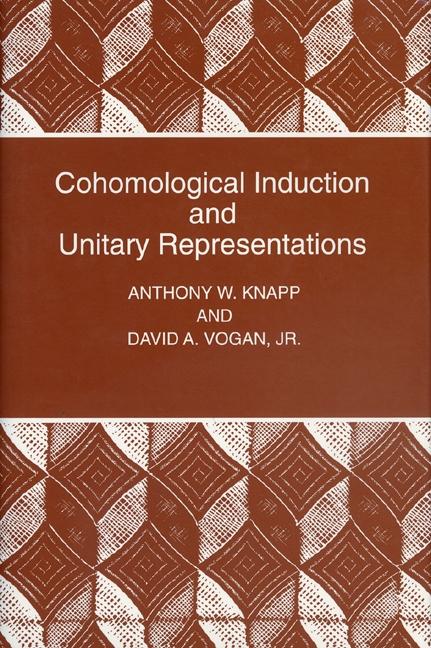
This book offers a systematic treatment--the first in book form--of the development and use of cohomological induction to construct unitary representations. George Mackey introduced induction in 1950 as a real analysis construction for passing from a unitary representation of a closed subgroup of a locally compact group to a unitary representation of the whole group. Later a parallel construction using complex analysis and its associated co-homology theories grew up as a result of work by Borel, Weil, Harish-Chandra, Bott, Langlands, Kostant, and Schmid. Cohomological induction, introduced by Zuckerman, is an algebraic analog that is technically more manageable than the complex-analysis construction and leads to a large repertory of irreducible unitary representations of reductive Lie groups.
The book, which is accessible to students beyond the first year of graduate school, will interest mathematicians and physicists who want to learn about and take advantage of the algebraic side of the representation theory of Lie groups. Cohomological Induction and Unitary Representations develops the necessary background in representation theory and includes an introductory chapter of motivation, a thorough treatment of the "translation principle," and four appendices on algebra and analysis.
Zahle einfach mit Karte, Klarna, Apple Pay oder Google Pay. Nicht zufrieden? Du hast immer ein 14-tägiges Widerrufsrecht. Lies mehr in unseren AGB. Hast du Fragen, schreib uns eine E-Mail an hello@memmo.org.
Memmo macht das Lernen einfacher – wo auch immer du bist. Bei uns findest du deine Kursbücher und smarte Lerntools an einem Ort: Zusammenfassungen, Quizzes, Podcasts und Lernkarten. Und Ted, dein Lernbuddy, beantwortet alles, was du wissen möchtest. Über 50.000 Studierende lernen bereits hier – gemacht, damit du schneller lernst und weniger Stress hast.