
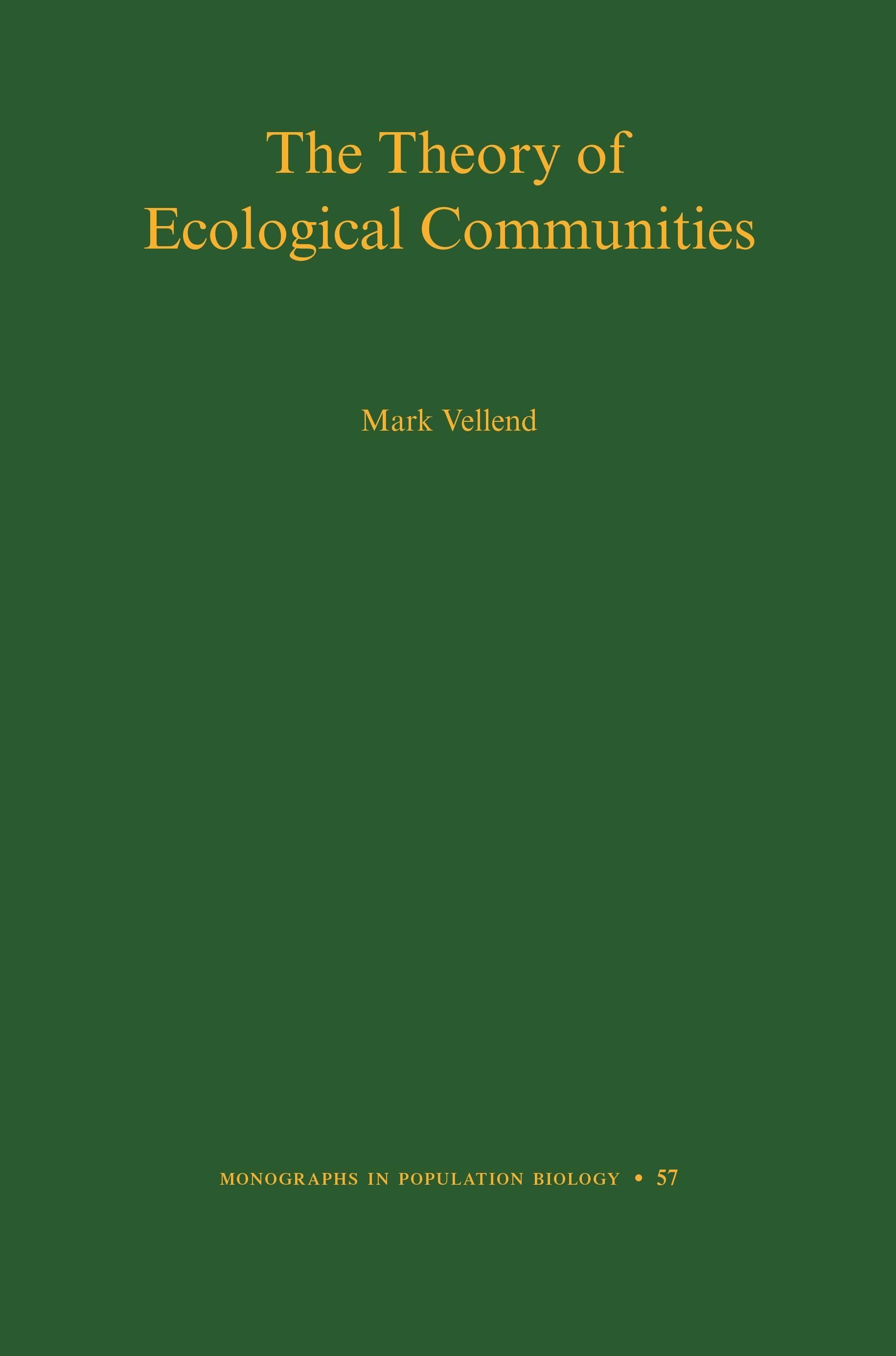
A plethora of different theories, models, and concepts make up the field of community ecology. Amid this vast body of work, is it possible to build one general theory of ecological communities? What other scientific areas might serve as a guiding framework? As it turns out, the core focus of community ecology—understanding patterns of diversity and composition of biological variants across space and time—is shared by evolutionary biology and its very coherent conceptual framework, population genetics theory. The Theory of Ecological Communities takes this as a starting point to pull together community ecology's various perspectives into a more unified whole.
Mark Vellend builds a theory of ecological communities based on four overarching processes: selection among species, drift, dispersal, and speciation. These are analogues of the four central processes in population genetics theory—selection within species, drift, gene flow, and mutation—and together they subsume almost all of the many dozens of more specific models built to describe the dynamics of communities of interacting species. The result is a theory that allows the effects of many low-level processes, such as competition, facilitation, predation, disturbance, stress, succession, colonization, and local extinction to be understood as the underpinnings of high-level processes with widely applicable consequences for ecological communities.
Reframing the numerous existing ideas in community ecology, The Theory of Ecological Communities provides a new way for thinking about biological composition and diversity.
Zahle einfach mit Karte, Klarna, Apple Pay oder Google Pay. Nicht zufrieden? Du hast immer ein 14-tägiges Widerrufsrecht. Lies mehr in unseren AGB. Hast du Fragen, schreib uns eine E-Mail an hello@memmo.org.
Memmo macht das Lernen einfacher – wo auch immer du bist. Bei uns findest du deine Kursbücher und smarte Lerntools an einem Ort: Zusammenfassungen, Quizzes, Podcasts und Lernkarten. Und Ted, dein Lernbuddy, beantwortet alles, was du wissen möchtest. Über 50.000 Studierende lernen bereits hier – gemacht, damit du schneller lernst und weniger Stress hast.