
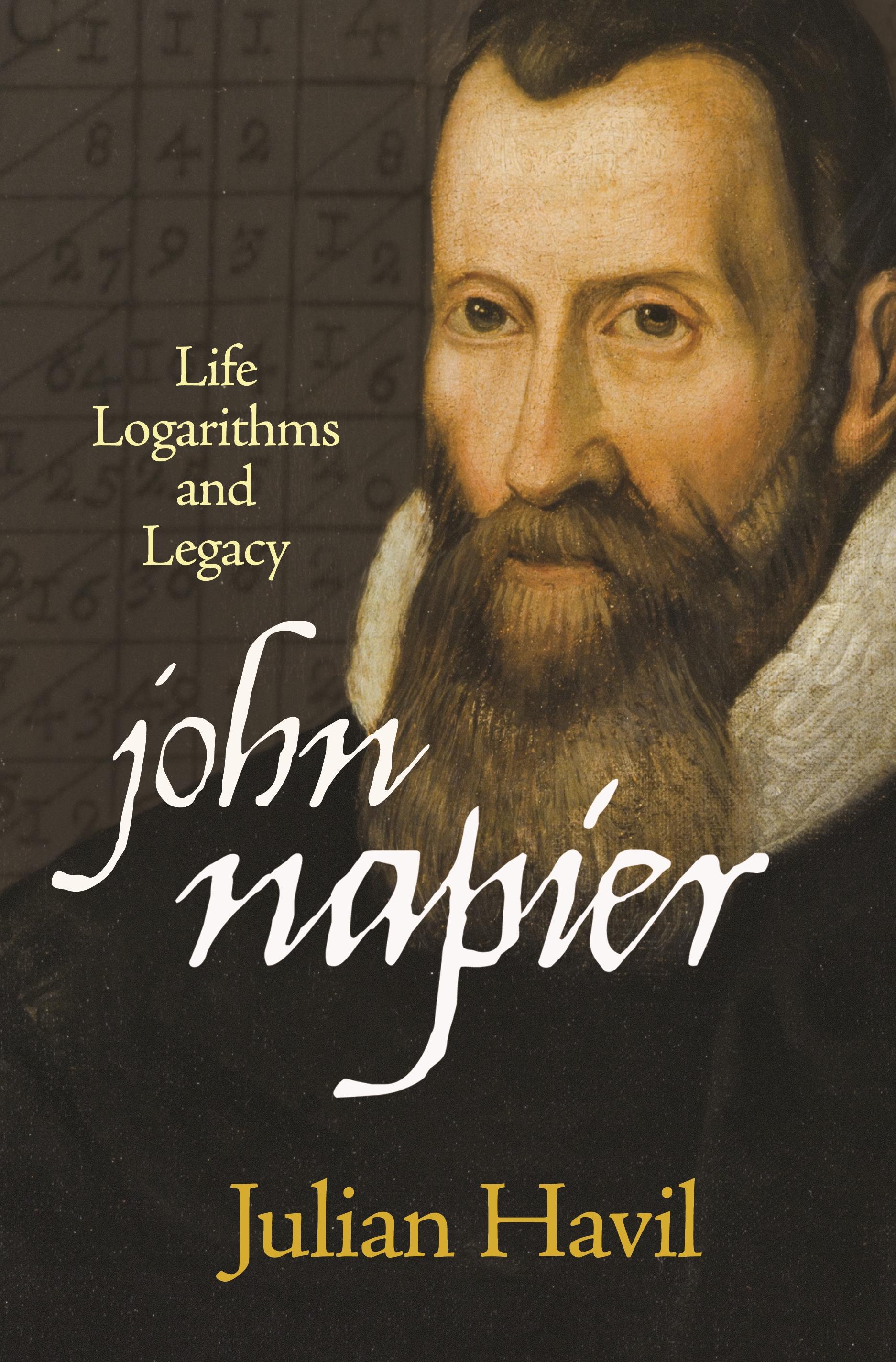
The most comprehensive account of the mathematician's life and work
John Napier (1550–1617) is celebrated today as the man who invented logarithms—an enormous intellectual achievement that would soon lead to the development of their mechanical equivalent in the slide rule: the two would serve humanity as the principal means of calculation until the mid-1970s. Yet, despite Napier's pioneering efforts, his life and work have not attracted detailed modern scrutiny. John Napier is the first contemporary biography to take an in-depth look at the multiple facets of Napier’s story: his privileged position as the eighth Laird of Merchiston and the son of influential Scottish landowners; his reputation as a magician who dabbled in alchemy; his interest in agriculture; his involvement with a notorious outlaw; his staunch anti-Catholic beliefs; his interactions with such peers as Henry Briggs, Johannes Kepler, and Tycho Brahe; and, most notably, his estimable mathematical legacy.
Julian Havil explores Napier’s original development of logarithms, the motivations for his approach, and the reasons behind certain adjustments to them. Napier’s inventive mathematical ideas also include formulas for solving spherical triangles, "Napier’s Bones" (a more basic but extremely popular alternative device for calculation), and the use of decimal notation for fractions and binary arithmetic. Havil also considers Napier’s study of the Book of Revelation, which led to his prediction of the Apocalypse in his first book, A Plaine Discovery of the Whole Revelation of St. John—the work for which Napier believed he would be most remembered.
John Napier assesses one man’s life and the lasting influence of his advancements on the mathematical sciences and beyond.
Zahle einfach mit Karte, Klarna, Apple Pay oder Google Pay. Nicht zufrieden? Du hast immer ein 14-tägiges Widerrufsrecht. Lies mehr in unseren AGB. Hast du Fragen, schreib uns eine E-Mail an hello@memmo.org.
Memmo macht das Lernen einfacher – wo auch immer du bist. Bei uns findest du deine Kursbücher und smarte Lerntools an einem Ort: Zusammenfassungen, Quizzes, Podcasts und Lernkarten. Und Ted, dein Lernbuddy, beantwortet alles, was du wissen möchtest. Über 50.000 Studierende lernen bereits hier – gemacht, damit du schneller lernst und weniger Stress hast.