
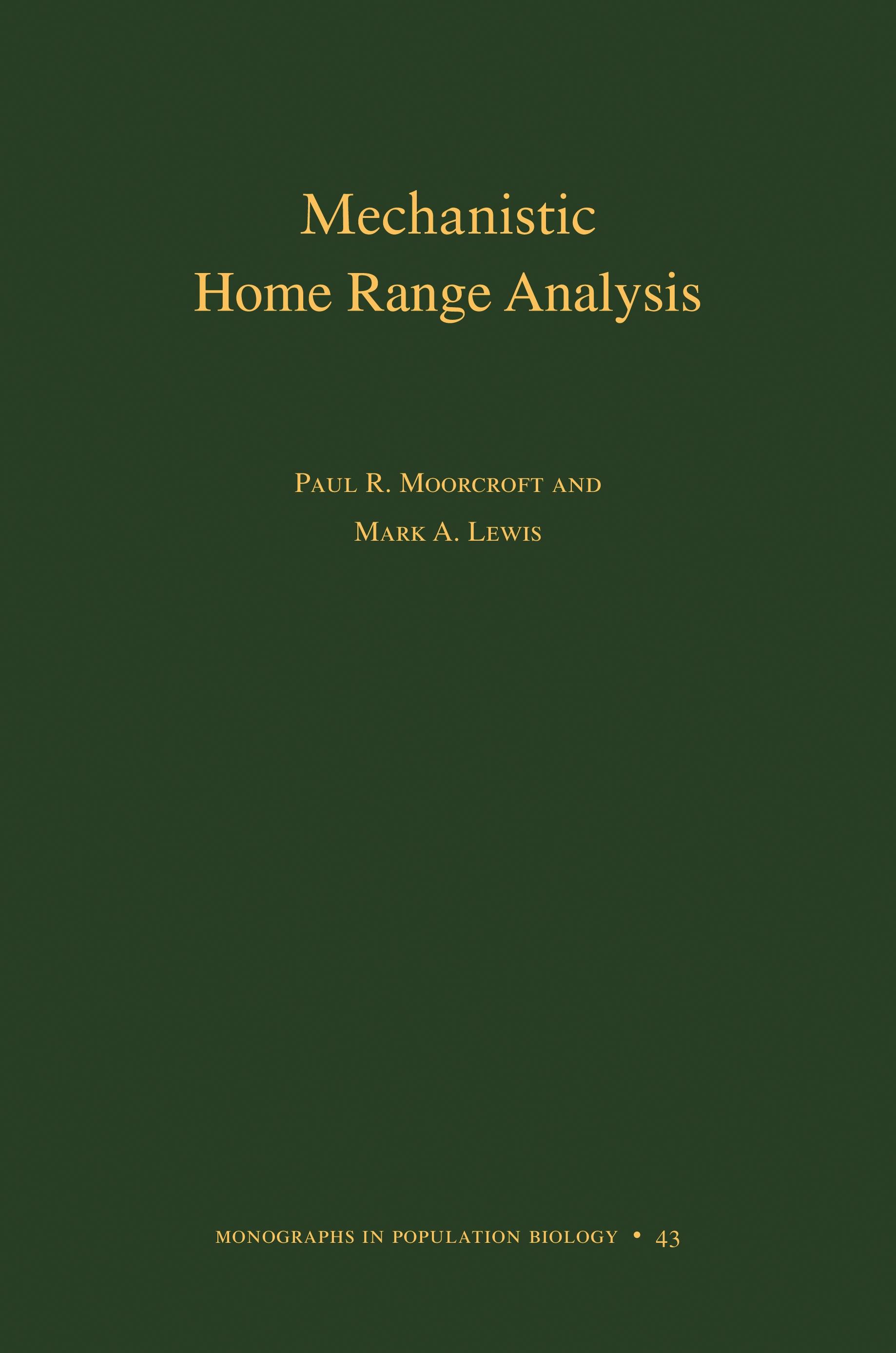
Spatial patterns of movement are fundamental to the ecology of animal populations, influencing their social organization, mating systems, demography, and the spatial distribution of prey and competitors. However, our ability to understand the causes and consequences of animal home range patterns has been limited by the descriptive nature of the statistical models used to analyze them. In Mechanistic Home Range Analysis, Paul Moorcroft and Mark Lewis develop a radically new framework for studying animal home range patterns based on the analysis of correlated random work models for individual movement behavior. They use this framework to develop a series of mechanistic home range models for carnivore populations.
The authors' analysis illustrates how, in contrast to traditional statistical home range models that merely describe pattern, mechanistic home range models can be used to discover the underlying ecological determinants of home range patterns observed in populations, make accurate predictions about how spatial distributions of home ranges will change following environmental or demographic disturbance, and analyze the functional significance of the movement strategies of individuals that give rise to observed patterns of space use.
By providing researchers and graduate students of ecology and wildlife biology with a more illuminating way to analyze animal movement, Mechanistic Home Range Analysis will be an indispensable reference for years to come.
Zahle einfach mit Karte, Klarna, Apple Pay oder Google Pay. Nicht zufrieden? Du hast immer ein 14-tägiges Widerrufsrecht. Lies mehr in unseren AGB. Hast du Fragen, schreib uns eine E-Mail an hello@memmo.org.
Memmo macht das Lernen einfacher – wo auch immer du bist. Bei uns findest du deine Kursbücher und smarte Lerntools an einem Ort: Zusammenfassungen, Quizzes, Podcasts und Lernkarten. Und Ted, dein Lernbuddy, beantwortet alles, was du wissen möchtest. Über 50.000 Studierende lernen bereits hier – gemacht, damit du schneller lernst und weniger Stress hast.