
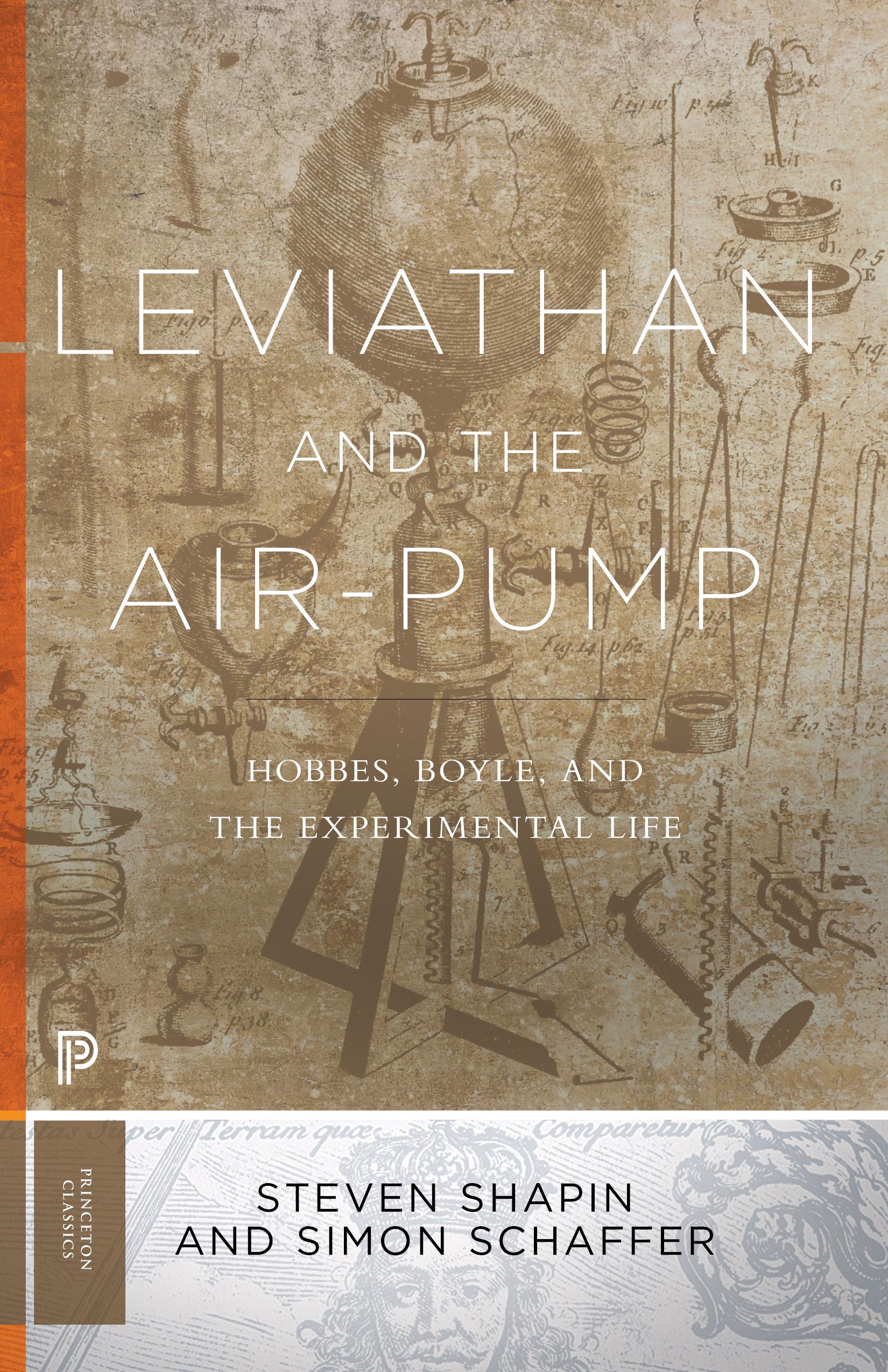
Leviathan and the Air-Pump examines the conflicts over the value and propriety of experimental methods between two major seventeenth-century thinkers: Thomas Hobbes, author of the political treatise Leviathan and vehement critic of systematic experimentation in natural philosophy, and Robert Boyle, mechanical philosopher and owner of the newly invented air-pump. The issues at stake in their disputes ranged from the physical integrity of the air-pump to the intellectual integrity of the knowledge it might yield. Both Boyle and Hobbes were looking for ways of establishing knowledge that did not decay into ad hominem attacks and political division. Boyle proposed the experiment as cure. He argued that facts should be manufactured by machines like the air-pump so that gentlemen could witness the experiments and produce knowledge that everyone agreed on. Hobbes, by contrast, looked for natural law and viewed experiments as the artificial, unreliable products of an exclusive guild.
The new approaches taken in Leviathan and the Air-Pump have been enormously influential on historical studies of science. Shapin and Schaffer found a moment of scientific revolution and showed how key scientific givens--facts, interpretations, experiment, truth--were fundamental to a new political order. Shapin and Schaffer were also innovative in their ethnographic approach. Attempting to understand the work habits, rituals, and social structures of a remote, unfamiliar group, they argued that politics were tied up in what scientists did, rather than what they said. Steven Shapin and Simon Schaffer use the confrontation between Hobbes and Boyle as a way of understanding what was at stake in the early history of scientific experimentation. They describe the protagonists' divergent views of natural knowledge, and situate the Hobbes-Boyle disputes within contemporary debates over the role of intellectuals in public life and the problems of social order and assent in Restoration England. In a new introduction, the authors describe how science and its social context were understood when this book was first published, and how the study of the history of science has changed since then.
Zahle einfach mit Karte, Klarna, Apple Pay oder Google Pay. Nicht zufrieden? Du hast immer ein 14-tägiges Widerrufsrecht. Lies mehr in unseren AGB. Hast du Fragen, schreib uns eine E-Mail an hello@memmo.org.
Memmo macht das Lernen einfacher – wo auch immer du bist. Bei uns findest du deine Kursbücher und smarte Lerntools an einem Ort: Zusammenfassungen, Quizzes, Podcasts und Lernkarten. Und Ted, dein Lernbuddy, beantwortet alles, was du wissen möchtest. Über 50.000 Studierende lernen bereits hier – gemacht, damit du schneller lernst und weniger Stress hast.