
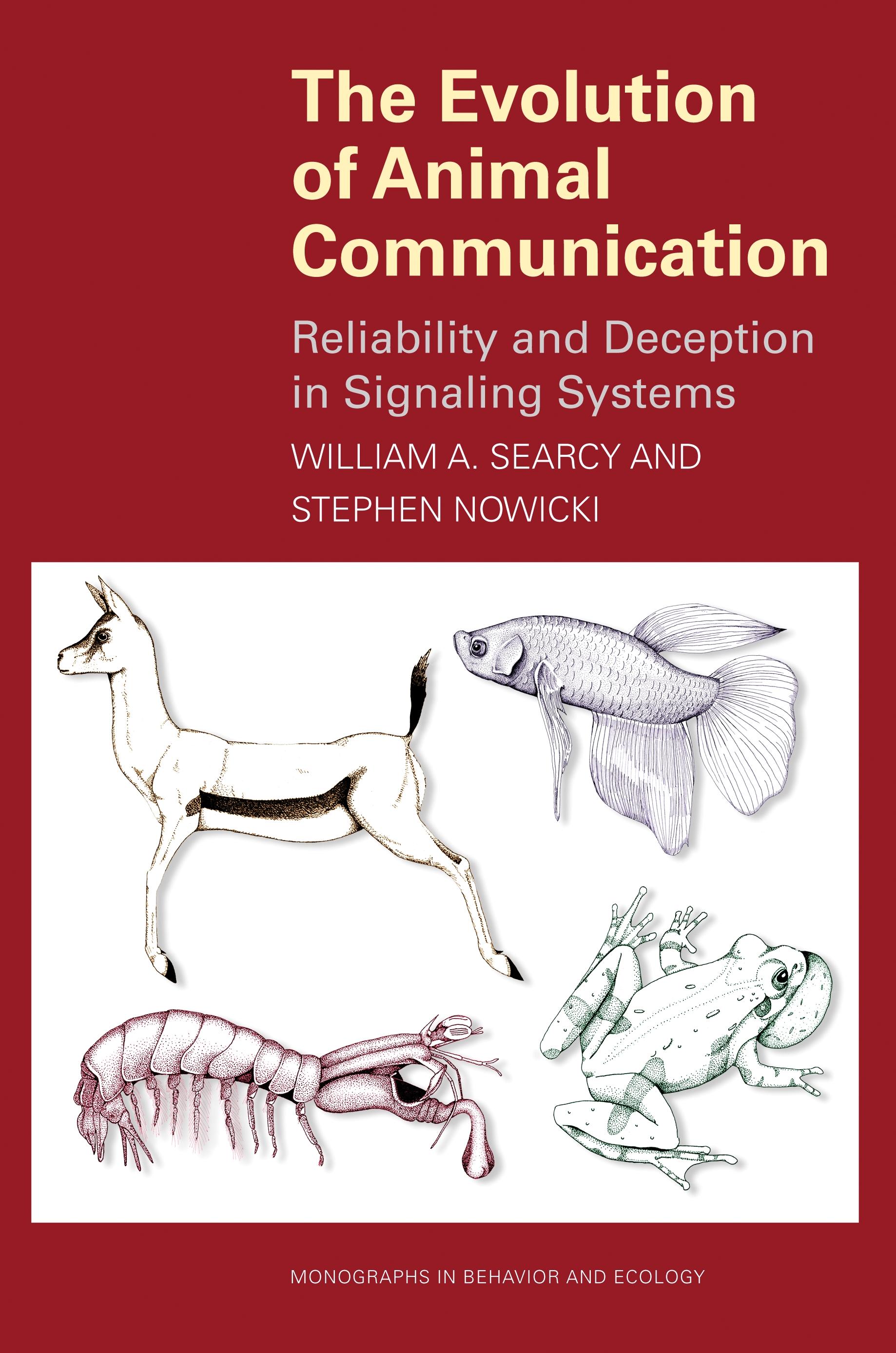
Gull chicks beg for food from their parents. Peacocks spread their tails to attract potential mates. Meerkats alert family members of the approach of predators. But are these--and other animals--sometimes dishonest? That's what William Searcy and Stephen Nowicki ask in The Evolution of Animal Communication. They take on the fascinating yet perplexing question of the dependability of animal signaling systems.
The book probes such phenomena as the begging of nesting birds, alarm calls in squirrels and primates, carotenoid coloration in fish and birds, the calls of frogs and toads, and weapon displays in crustaceans. Do these signals convey accurate information about the signaler, its future behavior, or its environment? Or do they mislead receivers in a way that benefits the signaler? For example, is the begging chick really hungry as its cries indicate or is it lobbying to get more food than its brothers and sisters?
Searcy and Nowicki take on these and other questions by developing clear definitions of key issues, by reviewing the most relevant empirical data and game theory models available, and by asking how well theory matches data. They find that animal communication is largely reliable--but that this basic reliability also allows the clever deceiver to flourish. Well researched and clearly written, their book provides new insight into animal communication, behavior, and evolution.
Zahle einfach mit Karte, Klarna, Apple Pay oder Google Pay. Nicht zufrieden? Du hast immer ein 14-tägiges Widerrufsrecht. Lies mehr in unseren AGB. Hast du Fragen, schreib uns eine E-Mail an hello@memmo.org.
Memmo macht das Lernen einfacher – wo auch immer du bist. Bei uns findest du deine Kursbücher und smarte Lerntools an einem Ort: Zusammenfassungen, Quizzes, Podcasts und Lernkarten. Und Ted, dein Lernbuddy, beantwortet alles, was du wissen möchtest. Über 50.000 Studierende lernen bereits hier – gemacht, damit du schneller lernst und weniger Stress hast.