
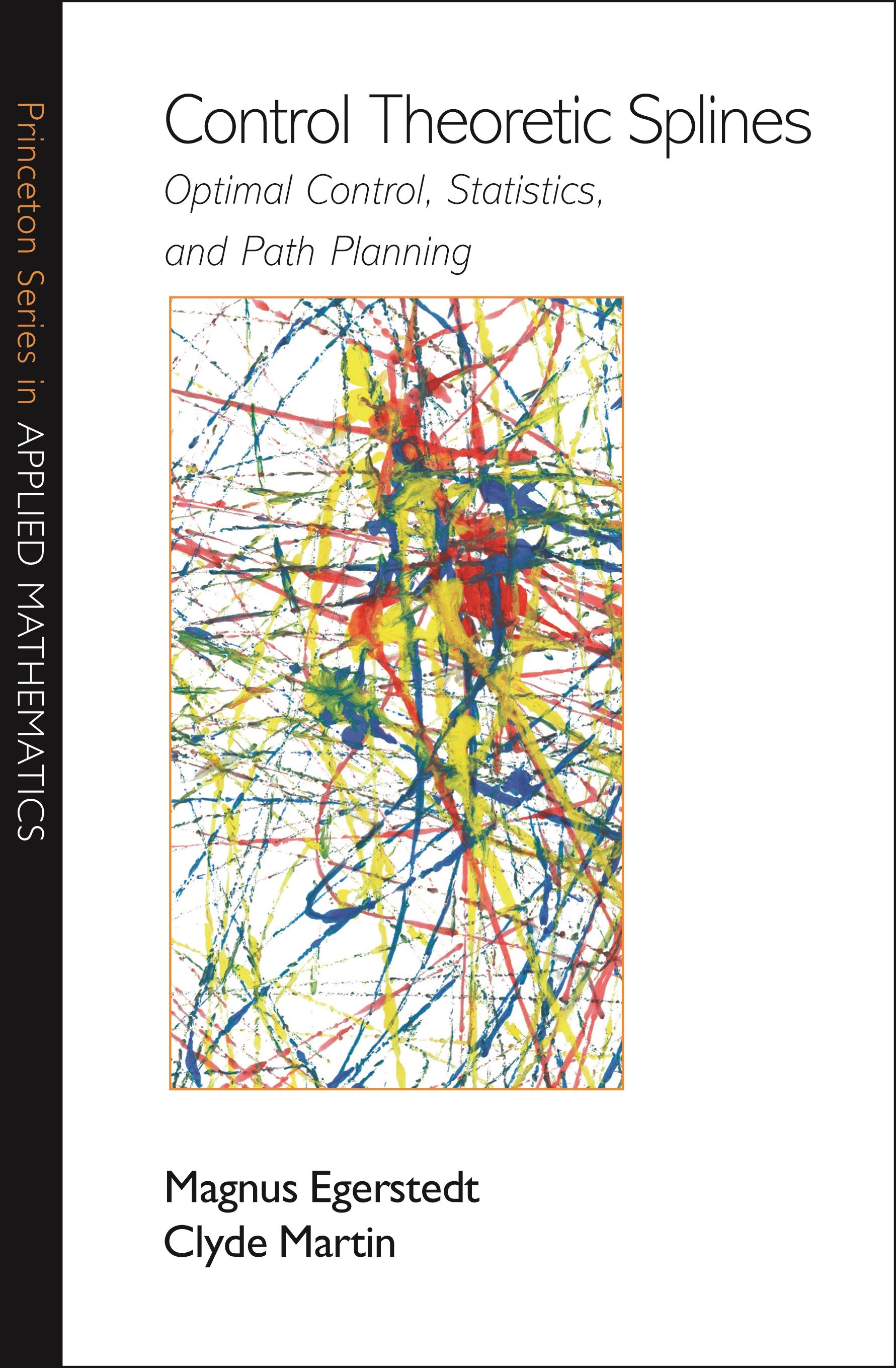
Splines, both interpolatory and smoothing, have a long and rich history that has largely been application driven. This book unifies these constructions in a comprehensive and accessible way, drawing from the latest methods and applications to show how they arise naturally in the theory of linear control systems. Magnus Egerstedt and Clyde Martin are leading innovators in the use of control theoretic splines to bring together many diverse applications within a common framework. In this book, they begin with a series of problems ranging from path planning to statistics to approximation. Using the tools of optimization over vector spaces, Egerstedt and Martin demonstrate how all of these problems are part of the same general mathematical framework, and how they are all, to a certain degree, a consequence of the optimization problem of finding the shortest distance from a point to an affine subspace in a Hilbert space. They cover periodic splines, monotone splines, and splines with inequality constraints, and explain how any finite number of linear constraints can be added. This book reveals how the many natural connections between control theory, numerical analysis, and statistics can be used to generate powerful mathematical and analytical tools.
This book is an excellent resource for students and professionals in control theory, robotics, engineering, computer graphics, econometrics, and any area that requires the construction of curves based on sets of raw data.
Zahle einfach mit Karte, Klarna, Apple Pay oder Google Pay. Nicht zufrieden? Du hast immer ein 14-tägiges Widerrufsrecht. Lies mehr in unseren AGB. Hast du Fragen, schreib uns eine E-Mail an hello@memmo.org.
Memmo macht das Lernen einfacher – wo auch immer du bist. Bei uns findest du deine Kursbücher und smarte Lerntools an einem Ort: Zusammenfassungen, Quizzes, Podcasts und Lernkarten. Und Ted, dein Lernbuddy, beantwortet alles, was du wissen möchtest. Über 50.000 Studierende lernen bereits hier – gemacht, damit du schneller lernst und weniger Stress hast.