
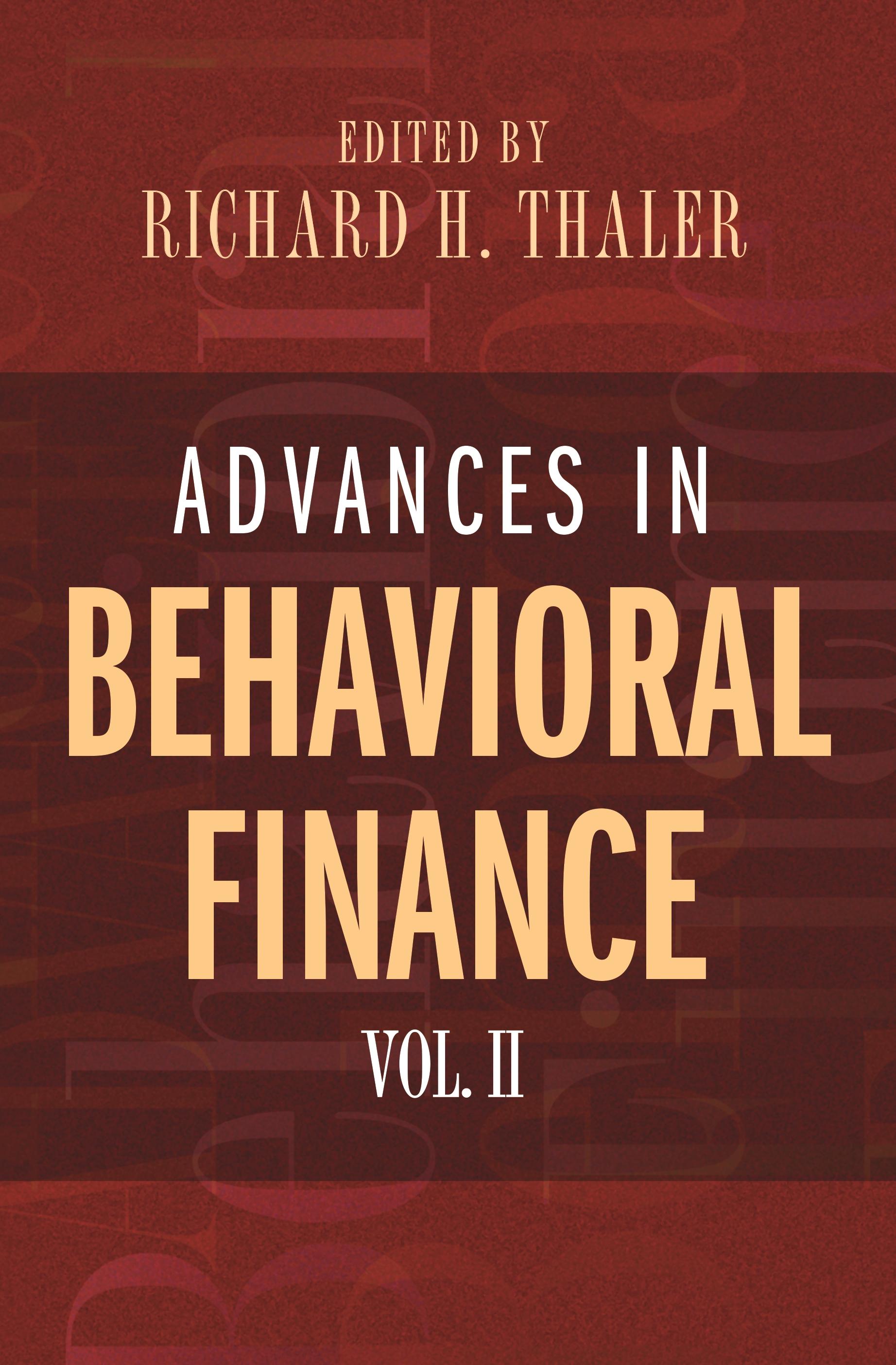
This book offers a definitive and wide-ranging overview of developments in behavioral finance over the past ten years. In 1993, the first volume provided the standard reference to this new approach in finance--an approach that, as editor Richard Thaler put it, "entertains the possibility that some of the agents in the economy behave less than fully rationally some of the time." Much has changed since then. Not least, the bursting of the Internet bubble and the subsequent market decline further demonstrated that financial markets often fail to behave as they would if trading were truly dominated by the fully rational investors who populate financial theories. Behavioral finance has made an indelible mark on areas from asset pricing to individual investor behavior to corporate finance, and continues to see exciting empirical and theoretical advances.
Advances in Behavioral Finance, Volume II constitutes the essential new resource in the field. It presents twenty recent papers by leading specialists that illustrate the abiding power of behavioral finance--of how specific departures from fully rational decision making by individual market agents can provide explanations of otherwise puzzling market phenomena. As with the first volume, it reaches beyond the world of finance to suggest, powerfully, the importance of pursuing behavioral approaches to other areas of economic life.
The contributors are Brad M. Barber, Nicholas Barberis, Shlomo Benartzi, John Y. Campbell, Emil M. Dabora, Daniel Kent, François Degeorge, Kenneth A. Froot, J. B. Heaton, David Hirshleifer, Harrison Hong, Ming Huang, Narasimhan Jegadeesh, Josef Lakonishok, Owen A. Lamont, Roni Michaely, Terrance Odean, Jayendu Patel, Tano Santos, Andrei Shleifer, Robert J. Shiller, Jeremy C. Stein, Avanidhar Subrahmanyam, Richard H. Thaler, Sheridan Titman, Robert W. Vishny, Kent L. Womack, and Richard Zeckhauser.
Zahle einfach mit Karte, Klarna, Apple Pay oder Google Pay. Nicht zufrieden? Du hast immer ein 14-tägiges Widerrufsrecht. Lies mehr in unseren AGB. Hast du Fragen, schreib uns eine E-Mail an hello@memmo.org.
Memmo macht das Lernen einfacher – wo auch immer du bist. Bei uns findest du deine Kursbücher und smarte Lerntools an einem Ort: Zusammenfassungen, Quizzes, Podcasts und Lernkarten. Und Ted, dein Lernbuddy, beantwortet alles, was du wissen möchtest. Über 50.000 Studierende lernen bereits hier – gemacht, damit du schneller lernst und weniger Stress hast.