
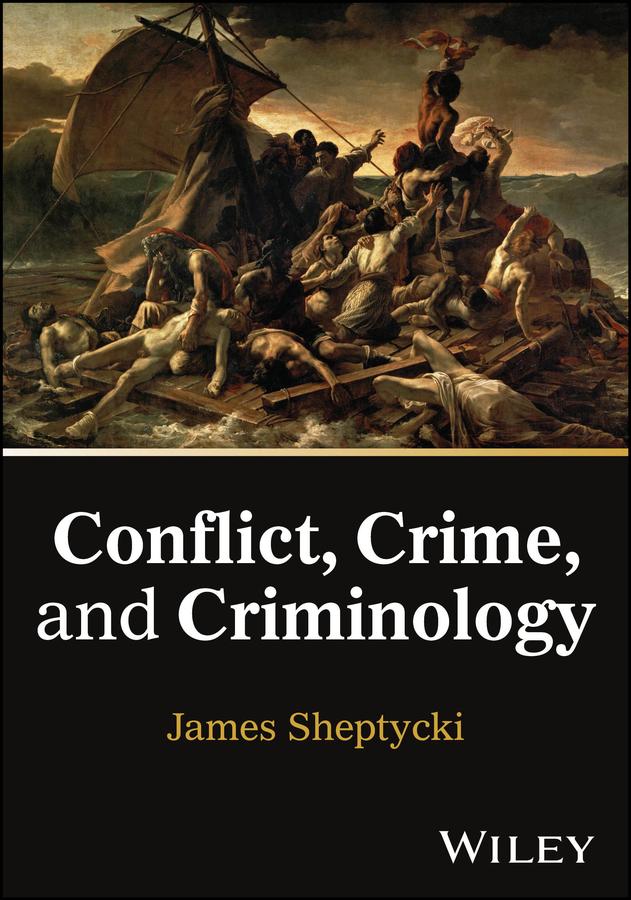
A new interdisciplinary approach to understanding conflict, power, control and criminality
Conflict, Crime and Criminology offers a novel approach to conceptualizing the ways conflict and power shape both crime and criminology. Exploring the issues from a global and transnational perspective, this book equips readers with insights for understanding interconnections involving the psycho-social, political, economic, and cultural conflicts that underlie both criminality and associated control responses. Drawing on decades of research and personal engagement working within the domain of criminology, James Sheptycki develops an innovative perspective on the history of the present that sheds light on contemporary global concerns and emergent possibilities for future inquiry.
The book's chronological structure follows Sheptycki's intellectual journey, making a self-reflective narrative about his adventures in criminology into a scholarly resource that sheds light on its evolution. Each chapter explores key phenomena—such as domestic violence, serial killers, drug criminalization, transnational organized crime, gun-crime and ecocide—revealing how conflict, power and control shape them. Engaging with issues from the local to the transnational, and drawing on insights from philosophy, history, sociology, and media studies, Sheptycki positions criminality as a symptom of deeper societal contradictions.
A reinvigoration of thinking about the enduring role of power and conflict in shaping crime and criminology for the twenty-first century, Conflict, Crime and Criminology: An Interdisciplinary Approach:
- Integrates theories from philosophy, sociology, psychology, political economy, and cultural studies
- Provides in-depth case studies, for example concerning gun crime in Toronto, corruption in British Columbia and transnational police assistance in Haiti
- Engages with emergent topics such as ecocide, human rights-based criminology, and the digital transformation of law enforcement
- Develops a theoretical model for understanding transnational organized crime and elite corruption
- Critiques cultural and media constructions of serial killers and public disorder
- Critically engages with feminist, Green, Southern, anti-racist, anti-colonial, left-realist, ultra-realist and conservative theoretical perspectives in criminology
- Addresses the post-democratic drift to authoritarianism characteristic of liquid modernity
Conflict, Crime and Criminology: An Interdisciplinary Approach is a thought-provoking book for teaching and learning in undergraduate, graduate, and doctoral-level courses in criminology, sociology, law, socio-legal studies, governance and politics, particularly for those concerned with globalization and the world system.
Zahle einfach mit Karte, Klarna, Apple Pay oder Google Pay. Nicht zufrieden? Du hast immer ein 14-tägiges Widerrufsrecht. Lies mehr in unseren AGB. Hast du Fragen, schreib uns eine E-Mail an hello@memmo.org.
Memmo macht das Lernen einfacher – wo auch immer du bist. Bei uns findest du deine Kursbücher und smarte Lerntools an einem Ort: Zusammenfassungen, Quizzes, Podcasts und Lernkarten. Und Ted, dein Lernbuddy, beantwortet alles, was du wissen möchtest. Über 50.000 Studierende lernen bereits hier – gemacht, damit du schneller lernst und weniger Stress hast.