
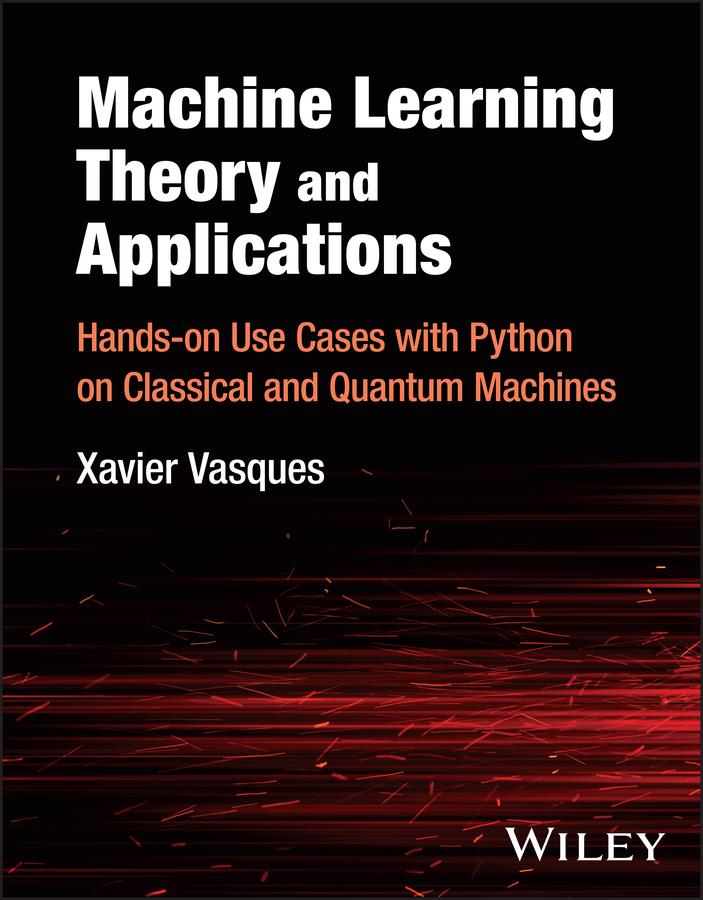
Enables readers to understand mathematical concepts behind data engineering and machine learning algorithms and apply them using open-source Python libraries
Machine Learning Theory and Applications delves into the realm of machine learning and deep learning, exploring their practical applications by comprehending mathematical concepts and implementing them in real-world scenarios using Python and renowned open-source libraries. This comprehensive guide covers a wide range of topics, including data preparation, feature engineering techniques, commonly utilized machine learning algorithms like support vector machines and neural networks, as well as generative AI and foundation models. To facilitate the creation of machine learning pipelines, a dedicated open-source framework named hephAIstos has been developed exclusively for this book. Moreover, the text explores the fascinating domain of quantum machine learning and offers insights on executing machine learning applications across diverse hardware technologies such as CPUs, GPUs, and QPUs. Finally, the book explains how to deploy trained models through containerized applications using Kubernetes and OpenShift, as well as their integration through machine learning operations (MLOps).
Additional topics covered in Machine Learning Theory and Applications include:
- Current use cases of AI, including making predictions, recognizing images and speech, performing medical diagnoses, creating intelligent supply chains, natural language processing, and much more
- Classical and quantum machine learning algorithms such as quantum-enhanced Support Vector Machines (QSVMs), QSVM multiclass classification, quantum neural networks, and quantum generative adversarial networks (qGANs)
- Different ways to manipulate data, such as handling missing data, analyzing categorical data, or processing time-related data
- Feature rescaling, extraction, and selection, and how to put your trained models to life and production through containerized applications
Machine Learning Theory and Applications is an essential resource for data scientists, engineers, and IT specialists and architects, as well as students in computer science, mathematics, and bioinformatics. The reader is expected to understand basic Python programming and libraries such as NumPy or Pandas and basic mathematical concepts, especially linear algebra.
Zahle einfach mit Karte, Klarna, Apple Pay oder Google Pay. Nicht zufrieden? Du hast immer ein 14-tägiges Widerrufsrecht. Lies mehr in unseren AGB. Hast du Fragen, schreib uns eine E-Mail an hello@memmo.org.
Memmo macht das Lernen einfacher – wo auch immer du bist. Bei uns findest du deine Kursbücher und smarte Lerntools an einem Ort: Zusammenfassungen, Quizzes, Podcasts und Lernkarten. Und Ted, dein Lernbuddy, beantwortet alles, was du wissen möchtest. Über 50.000 Studierende lernen bereits hier – gemacht, damit du schneller lernst und weniger Stress hast.