
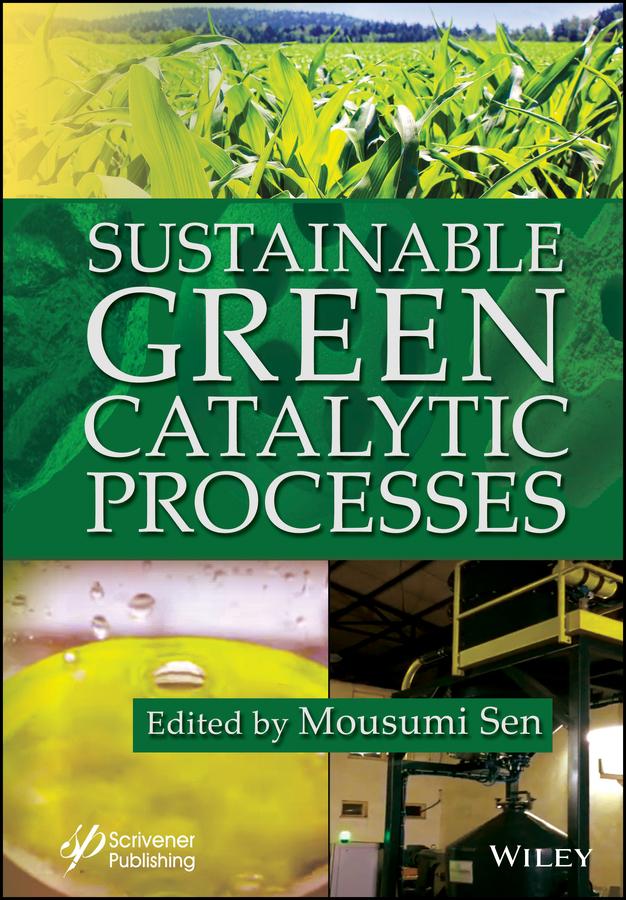
This groundbreaking book offers an in-depth description of sustainable green catalytic processes that have emerged as the means to empower the existing protocols with greener, sustainable, and environmentally benign versions that hold enormous potential in industry and society.
Growing worldwide concerns about environmental pollution and global warming have directed the attention of scientists towards approaches for developing sustainable protocols, and the need for employing greener and more sustainable catalytic approaches that are environmentally greener and more eco-friendly than current ones. Green and sustainable catalysts are the one class of catalysts that possess higher selectivity and activity, efficient recovery from the reaction medium, recyclability, cost-effectiveness and are prepared using environmentally benign preparation techniques. The most potent instrument in organic synthesis, and the cornerstone of green chemistry, is catalysis which has broadened the possibilities for organic transformations in the direction of a sustainable future. The catalyst has been playing a vital role, from the improvement of reaction conditions to enhanced selectivity towards the intended product and a decrease in the creation of byproducts. The purpose of this book is to highlight the developments made towards designing new catalysts (homogeneous, heterogeneous, organocatalyst, nanocatalyst, photocatalyst, nanophotocatalyst, biocatalyst, nanobiocatalyst, metal catalyst etc,.) and present the advancements in the field of chemical synthesis using greener catalytic routes with far-reaching applications.
The other environmentally friendly method is the enzymatic synthesis of organic molecules, which substitutes safe reagents for those that imitate the biosynthetic route to synthesize the desired organic molecules. With its ability to produce transformations that occasionally enable the reduction of steps in a synthetic route, biophotocatalysis has long been recognized as a green technology and key to creating environmentally friendly and sustainable chemistry. The employment of sustainable green processes on the most crucial reaction steps of the synthetic protocol satisfies contemporary needs for environmentally friendly operations during the creation of valuable chemicals.
Readers will find the book:
- details new catalysts development designs (homo and heterogeneous);
- presents the advancement of organic synthesis using greener catalytic routes with far-reaching applications;
- elaborates on preparation techniques for green and sustainable catalysts that possess higher activity, efficient recovery, and cost-effectiveness;
- discusses how to epitomize a green approach towards the preparation of organic moieties via enzymatic synthesis;
- analyzes nano-catalysis with green-based reagents and solvents that allow producers to follow the fundamental pillars of the green economy;
- elucidates green chemistry’s principles and metrics of the chemical’s life cycle and design through disposal.
Audience
The core audiences for this book include scientists and engineers working in green chemistry, materials science, photocatalysts, biotechnology, nanotechnology, waste minimization, and sustainability. This book is an excellent resource for graduate students, R&D experts, and researchers in academic and industrial fields of chemical synthesis.
Zahle einfach mit Karte, Klarna, Apple Pay oder Google Pay. Nicht zufrieden? Du hast immer ein 14-tägiges Widerrufsrecht. Lies mehr in unseren AGB. Hast du Fragen, schreib uns eine E-Mail an hello@memmo.org.
Memmo macht das Lernen einfacher – wo auch immer du bist. Bei uns findest du deine Kursbücher und smarte Lerntools an einem Ort: Zusammenfassungen, Quizzes, Podcasts und Lernkarten. Und Ted, dein Lernbuddy, beantwortet alles, was du wissen möchtest. Über 50.000 Studierende lernen bereits hier – gemacht, damit du schneller lernst und weniger Stress hast.