
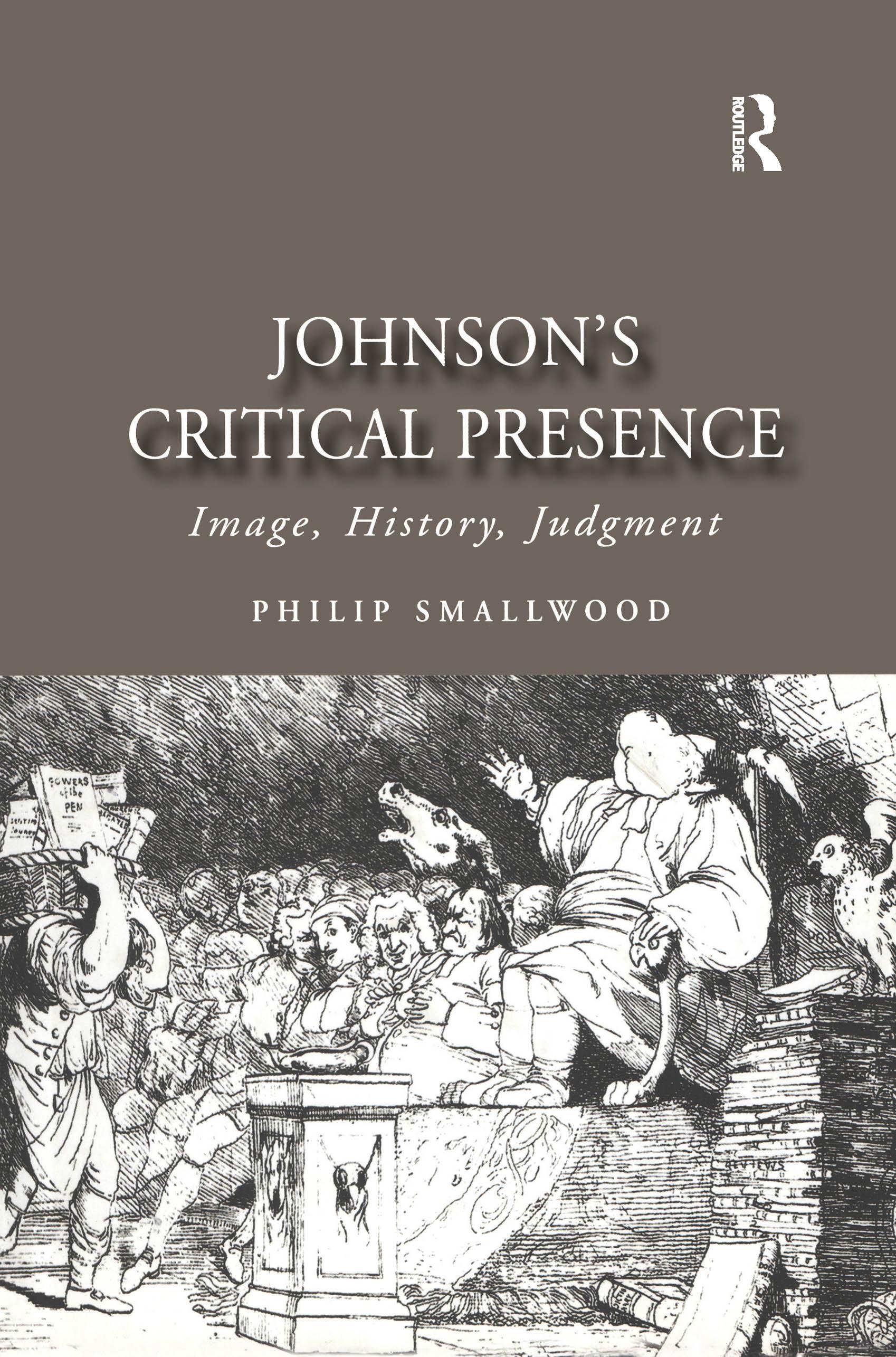
Samuel Johnson remains one of the most frequently discussed and cited of the eighteenth-century critics; but historians of criticism have invariably interpreted his work within conventions that have allowed for little evaluative commerce between the needs of the critical present and the voices of the critical past. Smallwood's argument is that Johnson's alienation from the modern critical scene stems in part from historians' tendency to tell the story of criticism as a narrative of improvement. The image of Johnson conceived by his antagonists in the eighteenth century has been perpetuated by romanticism, by nineteenth-century representational routines and mediated to the present day, most recently, by varieties of 'radical theory'. In Johnson's Critical Presence Smallwood offers a new account of Johnson's major critical writings conceived according to a different kind of historical potential. He suggests that the historicization of eighteenth-century criticism can best be understood in the light of the 'dialogic' and 'translational' historiographies of Collingwood, Gadamer and Ricoeur, and that the explanatory contexts of Johnson's criticism must include poetry in addition to theory; in this his study seeks to displace both the history of ideas as the leading paradigm for the history of criticism and to question the developmental narrative on which it relies. By in-depth analysis of Johnson's response to Shakespeare's plays and to the poetry of Abraham Cowley, Smallwood constructs a non-reductive context of emotional experience for Johnson's criticism. This embraces the dynamic satirical caricatures by James Gillray of Johnson as critic, the irony of Johnson's critical affinities with the major romantics, and is set against twentieth-century responses to the literary 'canon'. Smallwood argues that not only Johnson's emotional sensitivities, but also the ironic voices within the critical text itself, must be fully appreciated before Johnson's current relevance, or even his historical value, can be grasped.
Zahle einfach mit Karte, Klarna, Apple Pay oder Google Pay. Nicht zufrieden? Du hast immer ein 14-tägiges Widerrufsrecht. Lies mehr in unseren AGB. Hast du Fragen, schreib uns eine E-Mail an hello@memmo.org.
Memmo macht das Lernen einfacher – wo auch immer du bist. Bei uns findest du deine Kursbücher und smarte Lerntools an einem Ort: Zusammenfassungen, Quizzes, Podcasts und Lernkarten. Und Ted, dein Lernbuddy, beantwortet alles, was du wissen möchtest. Über 50.000 Studierende lernen bereits hier – gemacht, damit du schneller lernst und weniger Stress hast.
Das könnte dir auch gefallen
Buch kaufen0