
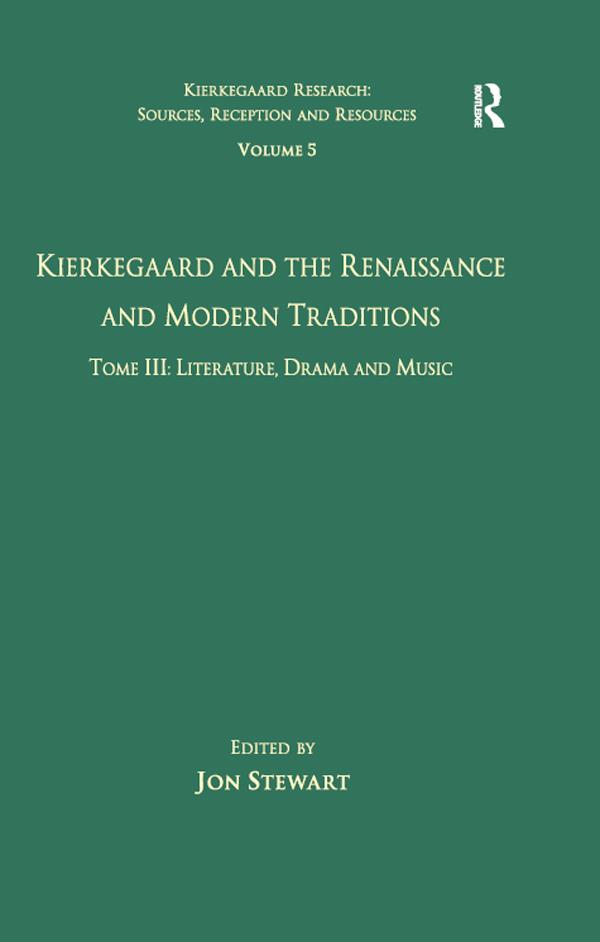
The long period from the Renaissance to the nineteenth century supplied numerous sources for Kierkegaard's thought in any number of different fields. The present, rather heterogeneous volume covers the long period from the birth of Savonarola in 1452 through the beginning of the nineteenth century and into Kierkegaard's own time. The Danish thinker read authors representing vastly different traditions and time periods. Moreover, he also read a diverse range of genres. His interests concerned not just philosophy, theology and literature but also drama and music. The present volume consists of three tomes that are intended to cover Kierkegaard's sources in these different fields of thought. Tome III covers the sources that are relevant for literature, drama and music. Kierkegaard was well read in the European literature of the seventeenth and eighteenth century. He was captivated by the figure of Cervantes' Don Quixote, who is used as a model for humor and irony. He also enjoyed French literature, represented here by articles on Chateaubriand, Lamartine, and Mérimée. French dramatists were popular on the Danish stage, and Kierkegaard demonstrated an interest in, among others, Moliére and Scribe. Although he never possessed strong English skills, this did not prevent him from familiarizing himself with English literature, primarily with the help of German translations. While there is an established body of secondary material on Kierkegaard's relation to Shakespeare, little has been said about his use of the Irish dramatist Sheridan. It is obvious from, among other things, The Concept of Irony that Kierkegaard knew in detail the works of some of the main writers of the German Romantic movement. However, his use of the leading figures of the British Romantic movement, Byron and Shelley, remains largely unexplored terrain. The classic Danish authors of the eighteenth century, Holberg, Wessel and Ewald, were influential figures who prepared the way for the Golden Age of Danish poetry. Kierkegaard constantly refers to their dramatic characters, whom he often employs to illustrate a philosophical idea with a pregnant example or turn of phrase. Finally, while Kierkegaard is not an obvious name in musicology, his analysis of Mozart's Don Giovanni shows that he had a keen interest in music on many different levels.
Zahle einfach mit Karte, Klarna, Apple Pay oder Google Pay. Nicht zufrieden? Du hast immer ein 14-tägiges Widerrufsrecht. Lies mehr in unseren AGB. Hast du Fragen, schreib uns eine E-Mail an hello@memmo.org.
Memmo macht das Lernen einfacher – wo auch immer du bist. Bei uns findest du deine Kursbücher und smarte Lerntools an einem Ort: Zusammenfassungen, Quizzes, Podcasts und Lernkarten. Und Ted, dein Lernbuddy, beantwortet alles, was du wissen möchtest. Über 50.000 Studierende lernen bereits hier – gemacht, damit du schneller lernst und weniger Stress hast.
Das könnte dir auch gefallen
Buch kaufen0