
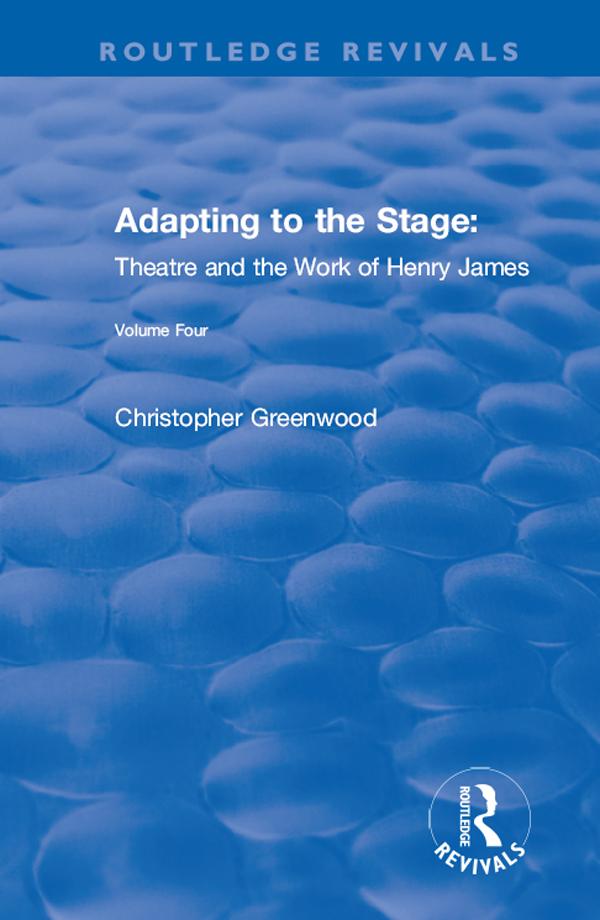
This title was first published in 2000: The American novelist and playwright, Henry James, was drawn to the theatre and the shifting conventions of drama throughout his writing career. This study demonstrates that from the 1890s onwards James concentrated on adapting his novels and stories to and from the stage, and increasingly employed metaphors that spoke of novel-writing in terms of playwriting. Christopher Greenwood argues that these metaphors helped James to conceive himself as an artist who composed characters dramatically and visually, and in doing so sets his novels significantly apart from those of his contemporaries. In the introduction to the first part of the book, Greenwood examines James's career within the context of contemporary European and North American theatre, providing an appraisal of what James gained from contemporary theatre, his position in that milieu, and what he brought to it. Part 2 of the book focuses on two novels: "The Other House" and "The Spoils of Poynton", both of which illustrate the ways in which James used the mechanism of contemporary theatre to communicate a character's personality. Discussion of these two works is used to throw light on similar concerns that develop in James's later writing.
Zahle einfach mit Karte, Klarna, Apple Pay oder Google Pay. Nicht zufrieden? Du hast immer ein 14-tägiges Widerrufsrecht. Lies mehr in unseren AGB. Hast du Fragen, schreib uns eine E-Mail an hello@memmo.org.
Memmo macht das Lernen einfacher – wo auch immer du bist. Bei uns findest du deine Kursbücher und smarte Lerntools an einem Ort: Zusammenfassungen, Quizzes, Podcasts und Lernkarten. Und Ted, dein Lernbuddy, beantwortet alles, was du wissen möchtest. Über 50.000 Studierende lernen bereits hier – gemacht, damit du schneller lernst und weniger Stress hast.