
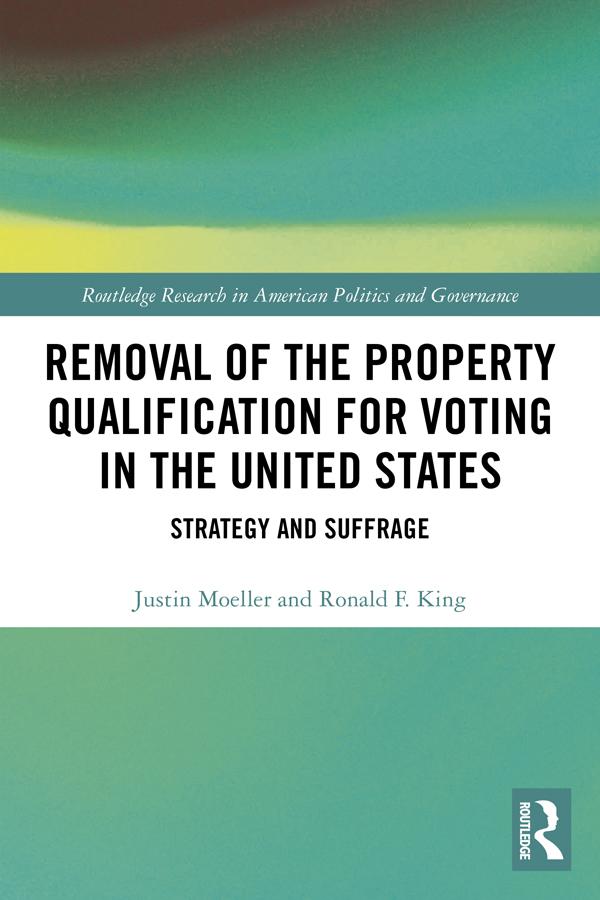
In Colonial America, democracy was centered in provincial assemblies and based on the collection of neighbors whose freehold ownership made them permanent stakeholders in the community. The removal of the property qualification for voting in the United States occurred over three-quarters of a century and was among the more important events in the history of democratization, functioning to shift voting from a corporate privilege toward a human right.
Moving beyond the standard histories of property standard histories of property qualification removal, Justin Moeller and Ronald F. King adopt the theories and methods of social science to discover underlying patterns and regularities, attempting a more systematic understanding of subject. While no historical event has a single cause, party consolidation and party competition provided a necessary mechanism, making background factors politically relevant. No change in franchise rules could occur without the explicit consent of incumbent politicians, always sensitive to the anticipated impact. Moeller and King argue that political parties acted strategically, accepting or rejecting removal of the property qualification as a means of advancing their electoral position. The authors identify four different variants of the strategic calculation variable, significantly helping to explain both the temporal differences across states and the pattern of contestation with each state individually.
Zahle einfach mit Karte, Klarna, Apple Pay oder Google Pay. Nicht zufrieden? Du hast immer ein 14-tägiges Widerrufsrecht. Lies mehr in unseren AGB. Hast du Fragen, schreib uns eine E-Mail an hello@memmo.org.
Memmo macht das Lernen einfacher – wo auch immer du bist. Bei uns findest du deine Kursbücher und smarte Lerntools an einem Ort: Zusammenfassungen, Quizzes, Podcasts und Lernkarten. Und Ted, dein Lernbuddy, beantwortet alles, was du wissen möchtest. Über 50.000 Studierende lernen bereits hier – gemacht, damit du schneller lernst und weniger Stress hast.