
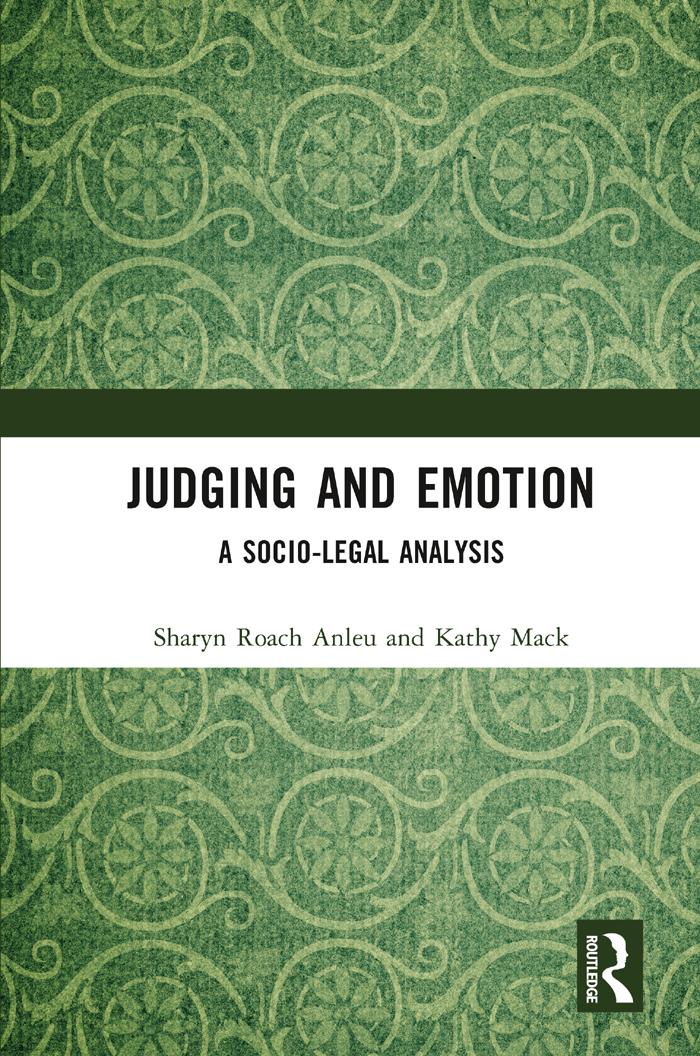
Judging and Emotion investigates how judicial officers understand, experience, display, manage and deploy emotions in their everyday work, in light of their fundamental commitment to impartiality.
Judging and Emotion challenges the conventional assumption that emotion is inherently unpredictable, stressful or a personal quality inconsistent with impartiality. Extensive empirical research with Australian judicial officers demonstrates the ways emotion, emotional capacities and emotion work are integral to judicial practice. Judging and Emotion articulates a broader conception of emotion, as a social practice emerging from interaction, and demonstrates how judicial officers undertake emotion work and use emotion as a resource to achieve impartiality. A key insight is that institutional requirements, including conceptions of impartiality as dispassion, do not completely determine the emotion dimensions of judicial work. Through their everyday work, judicial officers construct and maintain the boundaries of an impartial judicial role which necessarily incorporates emotion and emotion work.
Building on a growing interest in emotion in law and social sciences, this book will be of considerable importance to socio-legal scholars, sociologists, the judiciary, legal practitioners and all users of the courts.
Zahle einfach mit Karte, Klarna, Apple Pay oder Google Pay. Nicht zufrieden? Du hast immer ein 14-tägiges Widerrufsrecht. Lies mehr in unseren AGB. Hast du Fragen, schreib uns eine E-Mail an hello@memmo.org.
Memmo macht das Lernen einfacher – wo auch immer du bist. Bei uns findest du deine Kursbücher und smarte Lerntools an einem Ort: Zusammenfassungen, Quizzes, Podcasts und Lernkarten. Und Ted, dein Lernbuddy, beantwortet alles, was du wissen möchtest. Über 50.000 Studierende lernen bereits hier – gemacht, damit du schneller lernst und weniger Stress hast.