
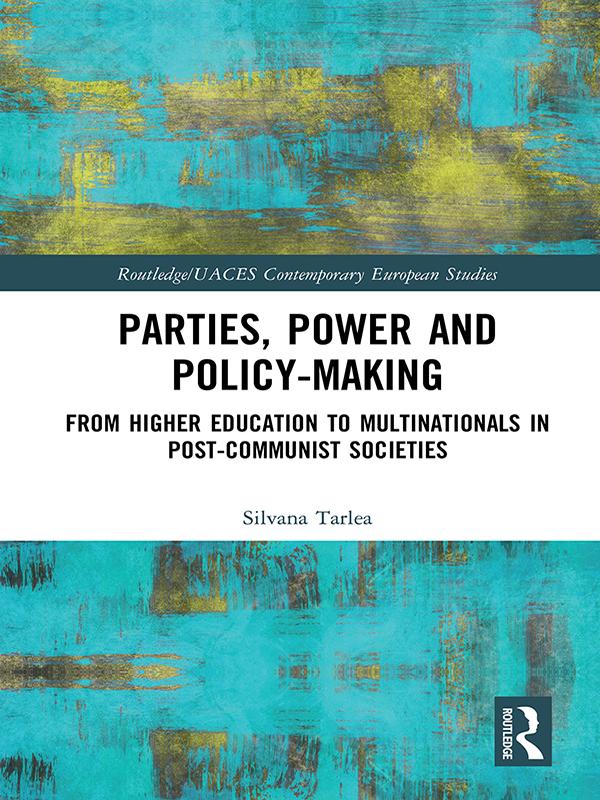
This book explains the conditions under which political parties in government were able to influence economic growth in post-communist European countries. It highlights higher education and international investment as the two essentially related areas that have been steered by governments.
The book illustrates how these countries have become reliant on multinational companies (MNCs), given their governments’ strategy to attract foreign capital, how political and economic factors are intertwined and how political parties in power can have a strong influence on the growth prospects of these economies. Furthermore, it illuminates the extent to which political parties use their space for manoeuvres when enacting policies and how they respond to their constituencies when doing so. It shows how structural conditions such as the dependence on MNCs influence policies, and how this pattern varies across Central and Eastern Europe. The book brings political parties back into the discussion on political economy and back into the analyses of welfare politics, varieties of capitalism, and democratic capitalism.
This text will be of key interest to scholars and students of comparative politics and comparative political economy, European policy-making, Central and Eastern Europe, trade, welfare and development, and higher education.
Zahle einfach mit Karte, Klarna, Apple Pay oder Google Pay. Nicht zufrieden? Du hast immer ein 14-tägiges Widerrufsrecht. Lies mehr in unseren AGB. Hast du Fragen, schreib uns eine E-Mail an hello@memmo.org.
Memmo macht das Lernen einfacher – wo auch immer du bist. Bei uns findest du deine Kursbücher und smarte Lerntools an einem Ort: Zusammenfassungen, Quizzes, Podcasts und Lernkarten. Und Ted, dein Lernbuddy, beantwortet alles, was du wissen möchtest. Über 50.000 Studierende lernen bereits hier – gemacht, damit du schneller lernst und weniger Stress hast.