
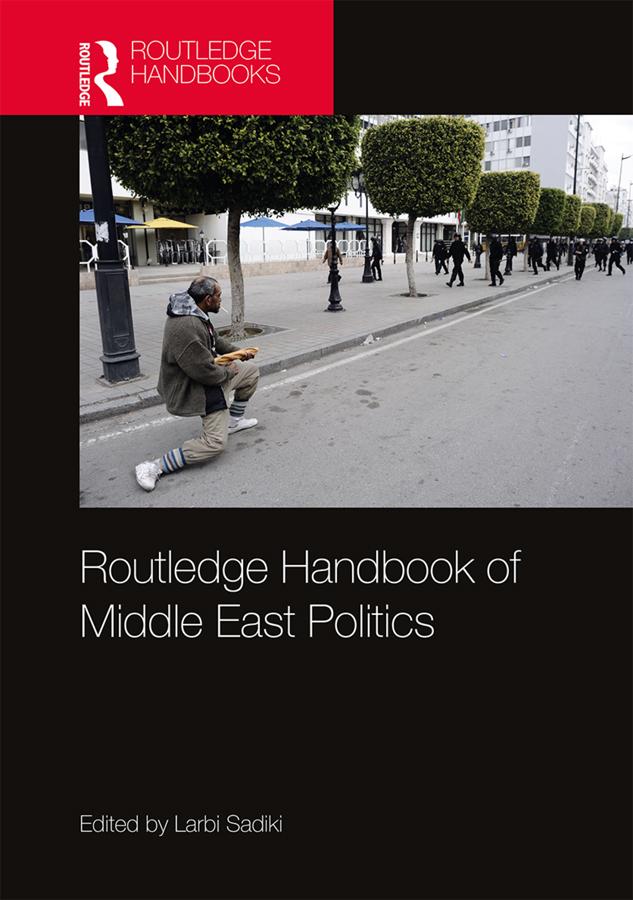
Drawing on various perspectives and analysis, the Handbook problematizes Middle East politics through an interdisciplinary prism, seeking a melioristic account of the field. Thematically organized, the chapters address political, social, and historical questions by showcasing both theoretical and empirical insights, all of which are represented in a style that ease readers into sophisticated induction in the Middle East.
It positions the didactic at the centre of inquiry. Contributions by forty-four scholars, both veterans and newcomers, rethink knowledge frames, conceptual categories, and fieldwork praxis. Substantive themes include secularity and religion, gender, democracy, authoritarianism, and new "borderline" politics of the Middle East. Like any field of knowledge, the Middle East is constituted by texts, authors, and readers, but also by the cultural, spatial, and temporal contexts within which diverse intellectual inflections help construct (write–speak) academic meaning, knowing, and practice. By denaturalizing notions of singularity of authorship or scholarship, the Handbook plants a dialogic interplay animated by multi-vocality, multi-modality, and multi-disciplinarity.
Targeting graduate students and young scholars of political and social sciences, the Handbook is significant for understanding how the Middle East is written and re-written, read and re-read (epistemology, methodology), and for how it comes to exist (ontology).
Zahle einfach mit Karte, Klarna, Apple Pay oder Google Pay. Nicht zufrieden? Du hast immer ein 14-tägiges Widerrufsrecht. Lies mehr in unseren AGB. Hast du Fragen, schreib uns eine E-Mail an hello@memmo.org.
Memmo macht das Lernen einfacher – wo auch immer du bist. Bei uns findest du deine Kursbücher und smarte Lerntools an einem Ort: Zusammenfassungen, Quizzes, Podcasts und Lernkarten. Und Ted, dein Lernbuddy, beantwortet alles, was du wissen möchtest. Über 50.000 Studierende lernen bereits hier – gemacht, damit du schneller lernst und weniger Stress hast.