
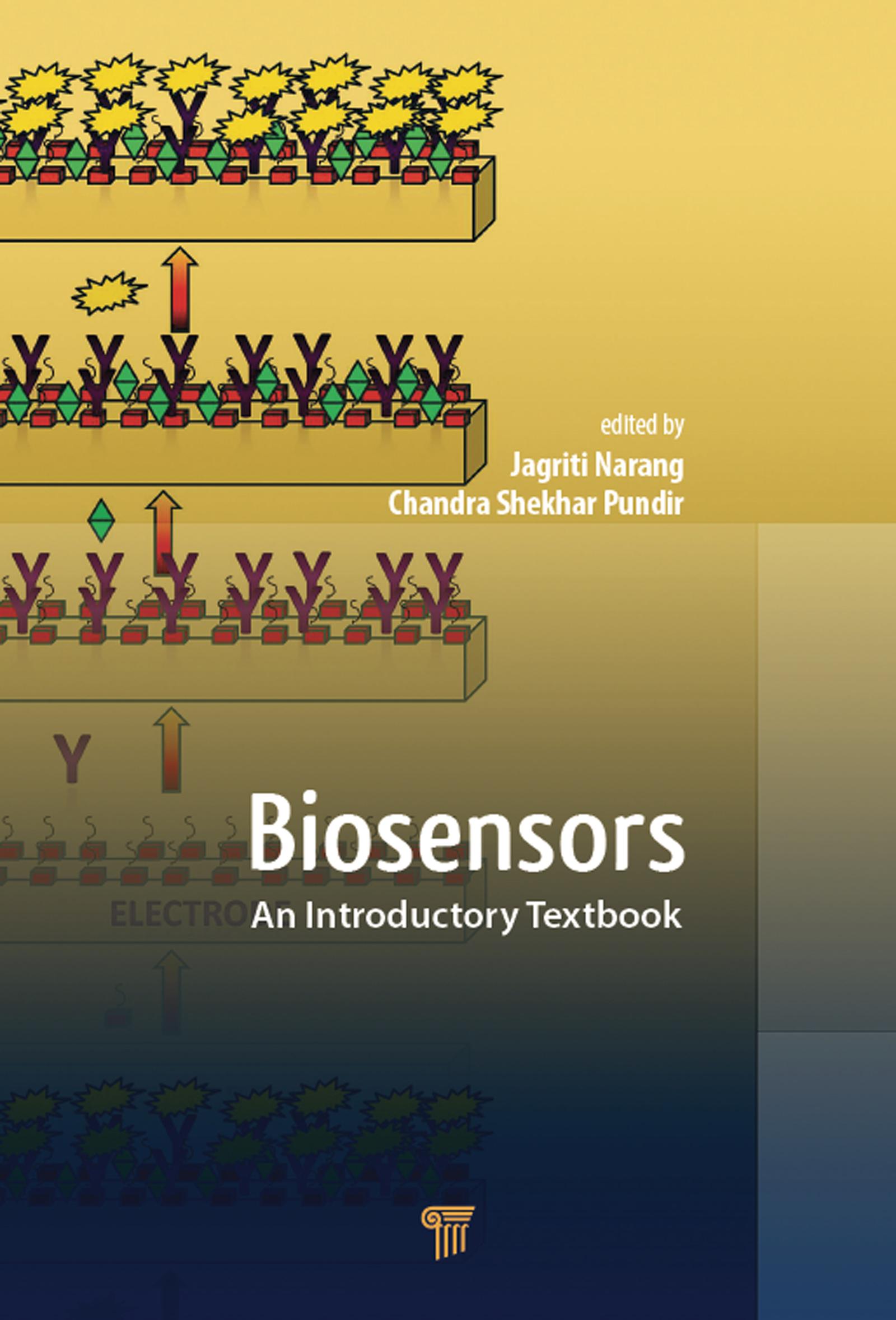
Nanotechnology is a budding field and has a pivotal role in sensing. Nanomaterials exist in various forms such as nanoparticles, nanoclusters, nanobelts, and nanospheres. These nanomaterials act as sensing interfaces and immobilization surfaces for various biomolecules such as enzymes, DNA, and antigens. Therefore, the preparation and characterization of these nanoparticles play an important role in sensing devices.
This handbook has evolved from the authors’ teaching and research experience in the field of nanoparticle biosensing. It encompasses protocols for the synthesis of various forms of metal oxide nanoparticles; study of the various characterizing techniques that help deduce the shape, size, and morphology of these nanoparticles; and applications of these nanoparticles in the field of biosensors. It presents voltammetry techniques such as cyclic, linear wave, wave pulse, and differential pulse voltammetry, throws light on the interactions of nanomaterials and biomolecules, and discusses microfluidic devices, which due to their unique capability of miniaturization fascinate many researchers. It is a practical and user-friendly textbook that introduces the various basic principles and practical information that will help undergraduate and advanced-level students and researchers understand the science behind nanoscale sensing.
Zahle einfach mit Karte, Klarna, Apple Pay oder Google Pay. Nicht zufrieden? Du hast immer ein 14-tägiges Widerrufsrecht. Lies mehr in unseren AGB. Hast du Fragen, schreib uns eine E-Mail an hello@memmo.org.
Memmo macht das Lernen einfacher – wo auch immer du bist. Bei uns findest du deine Kursbücher und smarte Lerntools an einem Ort: Zusammenfassungen, Quizzes, Podcasts und Lernkarten. Und Ted, dein Lernbuddy, beantwortet alles, was du wissen möchtest. Über 50.000 Studierende lernen bereits hier – gemacht, damit du schneller lernst und weniger Stress hast.