
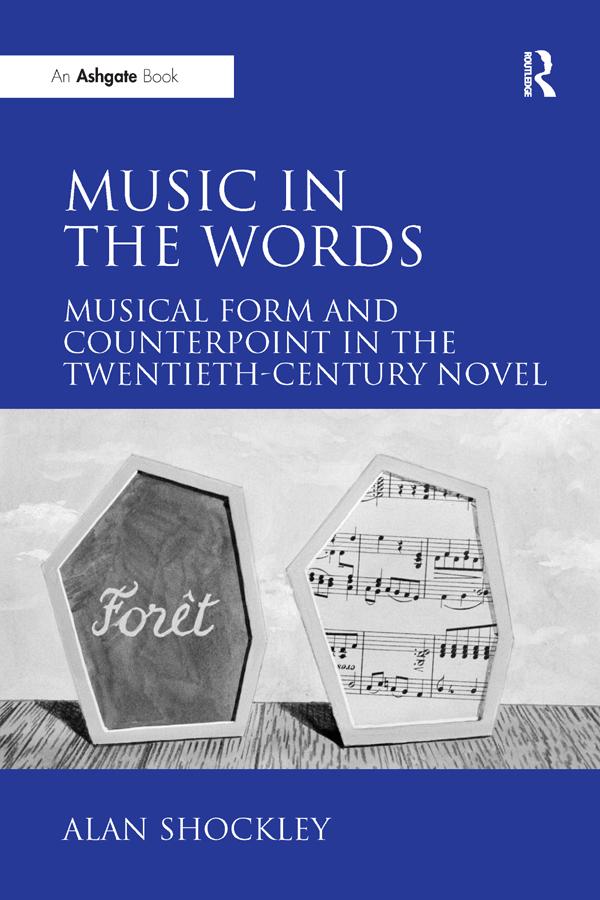
There is a strong tradition of literary analyses of the musical artwork. Simply put, all musicology - any writing about music - is an attempt at making analogies between what happens within the world of sound and language itself. This study considers this analogy from the opposite perspective: authors attempting to structure words using musical forms and techniques. It's a viewpoint much more rarely explored, and none of the extant studies of novelists' musical techniques have been done by musicians. Can a novel follow the form of a symphony and still succeed as a novel? Can musical counterpoint be mimicked by words on a page? Alan Shockley begins looking for answers by examining music's appeal for novelists, and then explores two brief works, a prose fugue by Douglas Hofstadter, and a short story by Anthony Burgess modeled after a Mozart symphony. Analyses of three large, emblematic attempts at musical writing follow. The much debated 'Sirens' episode of James Joyce's Ulysses, which the author famously likened to a fugue, Burgess' largely ignored Napoleon Symphony: A Novel in Four Movements, patterned on Beethoven's Eroica, and Joyce's Finnegans Wake, which Shockley examines as an attempt at composing a fully musicalized language. After these three larger analyses, Shockley discusses two quite recent brief novels, William Gaddis' novella Agap gape and David Markson's This is not a novel, proposing that each of these confounding texts coheres elegantly when viewed as a musically-structured work. From the perspective of a composer, Shockley offers the reader fresh tools for approaching these dense and often daunting texts.
Seiten: 206
Kategorie: Litteraturvetenskap & Teori
e-ISBN: 9781351557283
Versandgewicht: 1.2 kg
Versand in: 1-2 Tage
Zahle einfach mit Karte, Klarna, Apple Pay oder Google Pay. Nicht zufrieden? Du hast immer ein 14-tägiges Widerrufsrecht. Lies mehr in unseren AGB. Hast du Fragen, schreib uns eine E-Mail an hello@memmo.org.
Memmo macht das Lernen einfacher – wo auch immer du bist. Bei uns findest du deine Kursbücher und smarte Lerntools an einem Ort: Zusammenfassungen, Quizzes, Podcasts und Lernkarten. Und Ted, dein Lernbuddy, beantwortet alles, was du wissen möchtest. Über 50.000 Studierende lernen bereits hier – gemacht, damit du schneller lernst und weniger Stress hast.
Das könnte dir auch gefallen
Buch kaufen0