
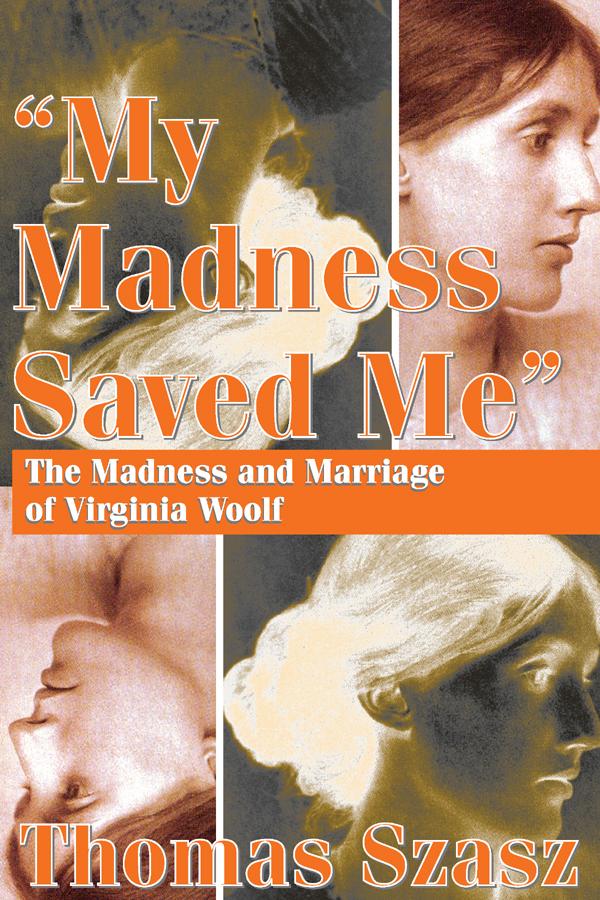
"The vast literature on Virginia Woolf's life, work, and marriage falls into two groups. A large majority is certain that she was mentally ill, and a small minority is equally certain that she was not mentally ill but was misdiagnosed by psychiatrists. In this daring exploration of Woolf's life and work, Thomas Szasz--famed for his radical critique of psychiatric concepts, coercions, and excuses--examines the evidence and rejects both views. Instead, he looks at how Virginia Woolf, as well as her husband Leonard, used the concept of madness and the profession of psychiatry to manage and manipulate their own and each other's lives.Do we explain achievement when we attribute it to the fictitious entity we call ""genius""? Do we explain failure when we attribute it to the fictitious entity we call ""madness""? Or do we deceive ourselves the same way that the person deceives himself when he attributes the easy ignition of hydrogen to its being ""flammable""? Szasz interprets Virginia Woolf's life and work as expressions of her character, and her character as the ""product"" of her free will. He offers this view as a corrective against the prevailing, ostensibly scientific view that attributes both her ""madness"" and her ""genius"" to biological-genetic causes. We tend to attribute exceptional achievement to genius, and exceptional failure to madness. Both, says Szasz, are fictitious entities."
Zahle einfach mit Karte, Klarna, Apple Pay oder Google Pay. Nicht zufrieden? Du hast immer ein 14-tägiges Widerrufsrecht. Lies mehr in unseren AGB. Hast du Fragen, schreib uns eine E-Mail an hello@memmo.org.
Memmo macht das Lernen einfacher – wo auch immer du bist. Bei uns findest du deine Kursbücher und smarte Lerntools an einem Ort: Zusammenfassungen, Quizzes, Podcasts und Lernkarten. Und Ted, dein Lernbuddy, beantwortet alles, was du wissen möchtest. Über 50.000 Studierende lernen bereits hier – gemacht, damit du schneller lernst und weniger Stress hast.
Das könnte dir auch gefallen
Buch kaufen0