
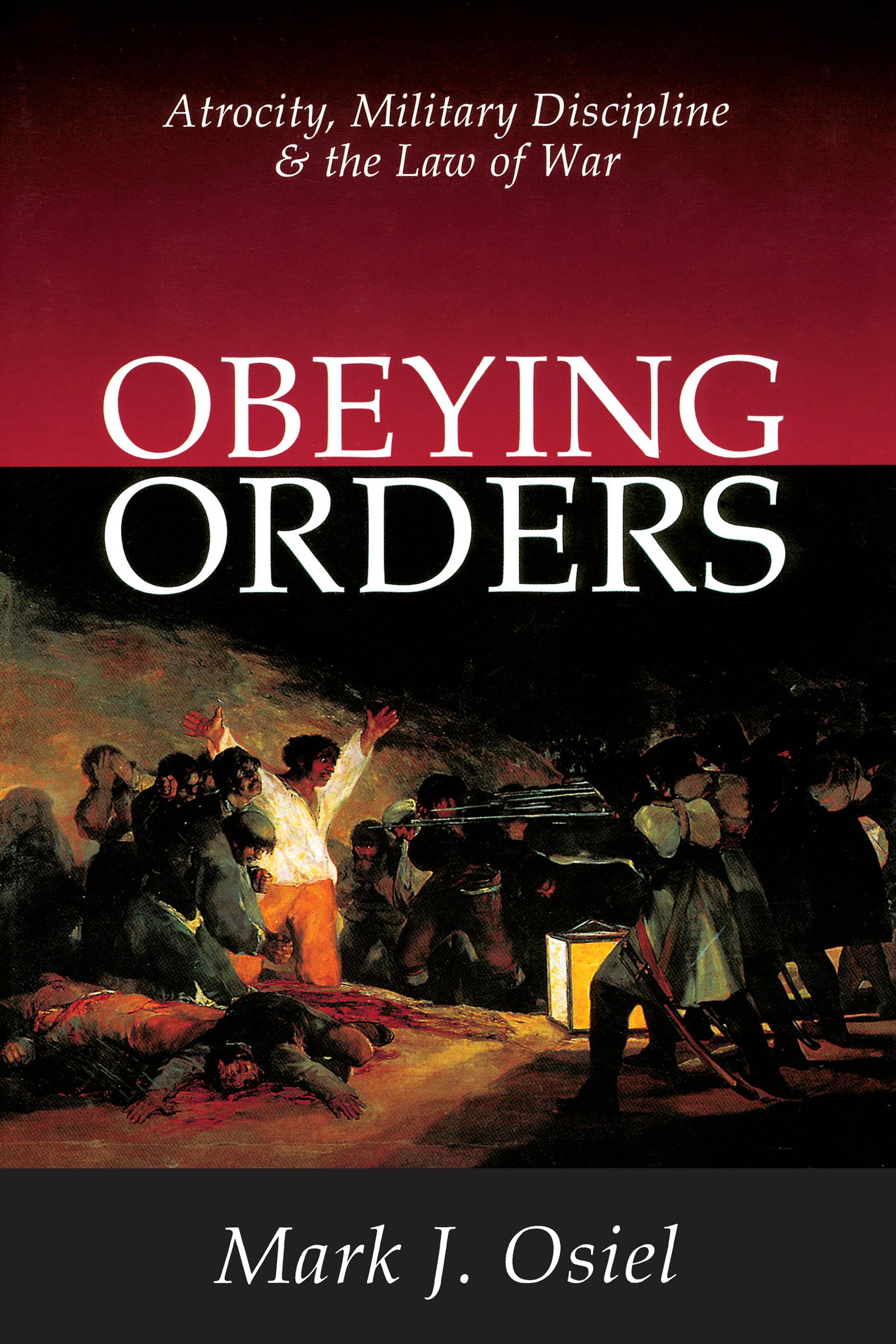
A soldier obeys illegal orders, thinking them lawful. When should we excuse his misconduct as based in reasonable error? How can courts convincingly convict the soldier's superior officer when, after Nuremberg, criminal orders are expressed through winks and nods, hints and insinuations? Can our notions of the soldier's "due obedience," designed for the Roman legionnaire, be brought into closer harmony with current understandings of military conflict in the contemporary world? Mark J. Osiel answers these questions in light of new learning about atrocity and combat cohesion, as well as changes in warfare and the nature of military conflict. Sources of atrocity are far more varied than current law assumes, and such variations display consistent patterns. The law now generally requires that soldiers resolve all doubts about the legality of a superior's order in favor of obedience. It excuses compliance with an illegal order unless the illegality - as with flagrant atrocities - would be immediately obvious to anyone. But these criteria are often in conflict and at odds with the law's underlying principles and policies. Combat and peace operations now depend more on tactical imagination, self-discipline, and loyalty to immediate comrades than on immediate, unreflective adherence to the letter of superiors' orders, backed by threat of formal punishment. The objective of military law is to encourage deliberative judgment. This can be done, Osiel suggests, in ways that enhance the accountability of our military forces, in both peace operations and more traditional conflicts, while maintaining their effectiveness. Osiel seeks to "civilianize" military law while building on soldiers' own internal ideals of professional virtuousness. He returns to the ancient ideal of martial honor, reinterpreting it in light of new conditions, arguing that it should be implemented through realistic training in which legal counsel plays an enlarged role rather than by threat of legal prosecution. Obeying Orders thus offers a compelling answer to the question that has most haunted the moral imagination of the late twentieth century: the roots - and restraint - of mass atrocity in war.
Zahle einfach mit Karte, Klarna, Apple Pay oder Google Pay. Nicht zufrieden? Du hast immer ein 14-tägiges Widerrufsrecht. Lies mehr in unseren AGB. Hast du Fragen, schreib uns eine E-Mail an hello@memmo.org.
Memmo macht das Lernen einfacher – wo auch immer du bist. Bei uns findest du deine Kursbücher und smarte Lerntools an einem Ort: Zusammenfassungen, Quizzes, Podcasts und Lernkarten. Und Ted, dein Lernbuddy, beantwortet alles, was du wissen möchtest. Über 50.000 Studierende lernen bereits hier – gemacht, damit du schneller lernst und weniger Stress hast.
Das könnte dir auch gefallen
Buch kaufen0