
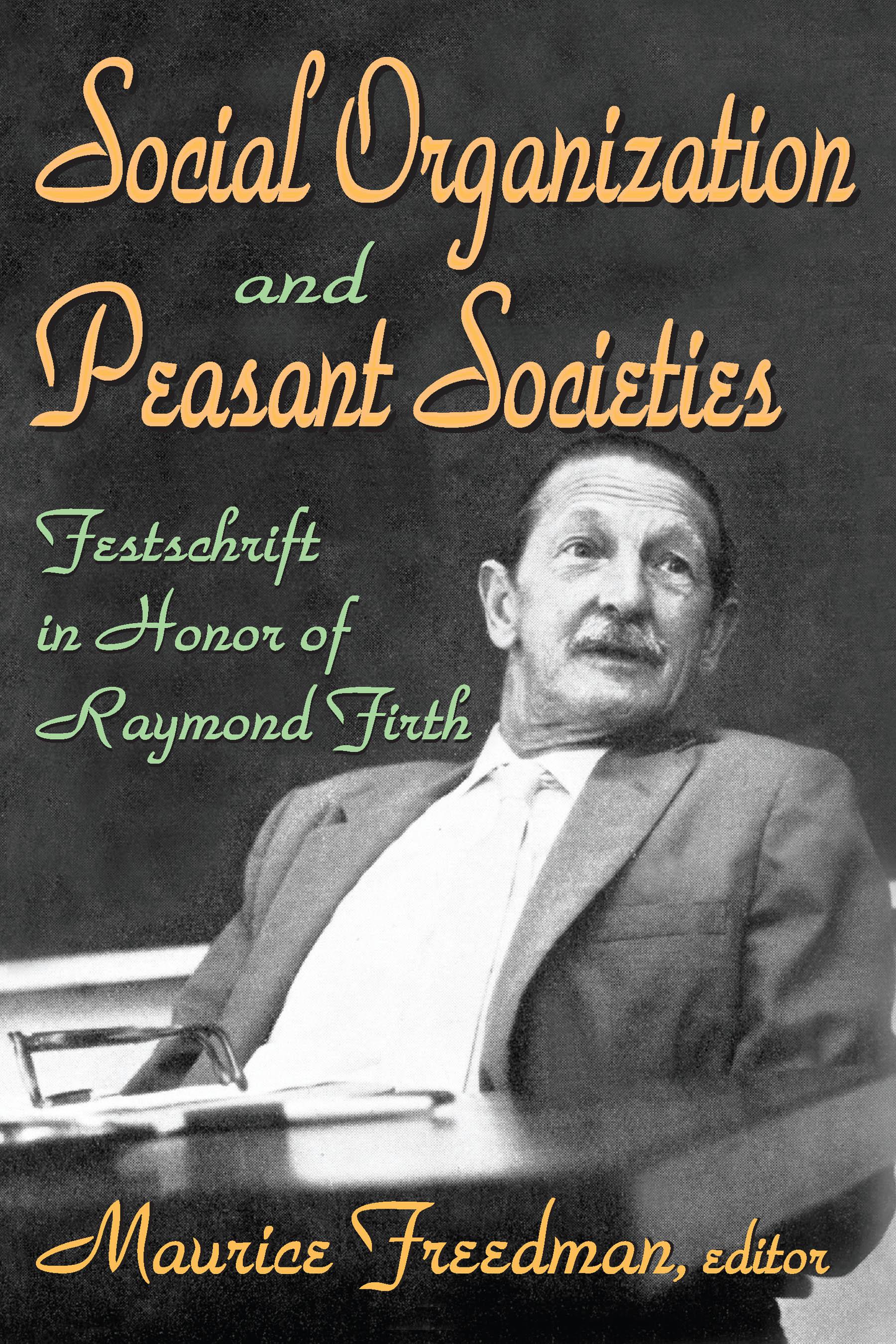
The essays included in Social Organization and Peasant Societies were written in honor of the man who taught their authors. Each entry is about different problems within the general field of "social organization."They were composed in many styles; and deal ethnographically with a heterogeneous collection of peoples and countries. Together they illustrate an important aspect of Firth's influence as a teacher: the range of his interests and his success in promoting social anthropological research on the broadest front.The breadth and the variety in the work of his students reflect Firth's own catholicity. From economics he reached into every corner of the field covered by social anthropology, and many of his interests can be traced in these essays on themes in kinship and marriage (by Baric, Benedict, Kaberry, and Leach) and on religious subjects (by Freedman, Morris, and Stanner). Still more detail the study of modern social change (by Little and Mayer). There is even one is on art (by Forge). Three are devoted to subjects in economic anthropology (by Belshaw, Swift, and Ward). On all of these varied and complex topics Raymond Firth has written extensively and taught untiringly. Many of the contributors to his festschrift are themselves leading anthropologists.Raymond Firth's importance in the history of social anthropology is undisputed. He came into the profession when it was small and unformed, when it existed only in the tiny groups of people around Malinowski and Radcliffe-Brown. He urged it on, by intellectual leadership, by careful organization, and by devoted service. He was one of a small band of scholars; he created a large school. He inherited an esoteric seminar from Malinowski; he turned it into a great class where, over the years, hundreds of students marveled at his skill and learned their craft as analysts and field workers. His protege listened to his formulation of problems, his critique of methods, and his courteous but un
Zahle einfach mit Karte, Klarna, Apple Pay oder Google Pay. Nicht zufrieden? Du hast immer ein 14-tägiges Widerrufsrecht. Lies mehr in unseren AGB. Hast du Fragen, schreib uns eine E-Mail an hello@memmo.org.
Memmo macht das Lernen einfacher – wo auch immer du bist. Bei uns findest du deine Kursbücher und smarte Lerntools an einem Ort: Zusammenfassungen, Quizzes, Podcasts und Lernkarten. Und Ted, dein Lernbuddy, beantwortet alles, was du wissen möchtest. Über 50.000 Studierende lernen bereits hier – gemacht, damit du schneller lernst und weniger Stress hast.
Das könnte dir auch gefallen
Buch kaufen0