
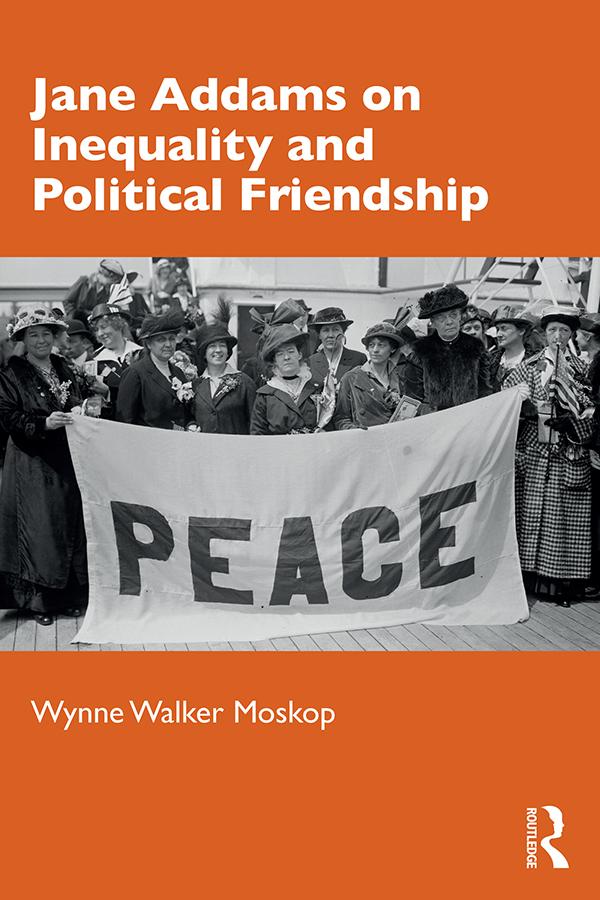
In this book, Wynne Walker Moskop addresses the practical and theoretical problem of how unequal political friendships evolve toward arrangements the parties consider reciprocal and just, a problem neglected by scholars of democracy who associate reciprocity and justice only with equal parties. Jane Addams insisted that Hull House was not a charity with philanthropic aspirations; rather it had to bring “two classes” to a shared purpose and more egalitarian relation. The problem was, and still is, how?
Drawing on several bodies of scholarship—including Addams’s writings, secondary works about her collaborations, literature on Aristotelian political friendship, and feminist scholarship on the global migration of care workers—Moskop shows the importance of Addams’s practices to the continuing relevance of unequal economic relations for shaping political friendship.
Contributing to a lively conversation about Addams’s work as a pragmatist thinker and social reformer that began three decades ago, Jane Addams on Inequality and Political Friendship is an invaluable resource to students of democratic theory, feminist political theory and philosophy, and American pragmatism. It illuminates the importance of overlooked conditions for friendship and justice in unequal relations, given people’s ongoing subordination because of race, class, gender, and citizenship status in the U.S. and transnationally.
Zahle einfach mit Karte, Klarna, Apple Pay oder Google Pay. Nicht zufrieden? Du hast immer ein 14-tägiges Widerrufsrecht. Lies mehr in unseren AGB. Hast du Fragen, schreib uns eine E-Mail an hello@memmo.org.
Memmo macht das Lernen einfacher – wo auch immer du bist. Bei uns findest du deine Kursbücher und smarte Lerntools an einem Ort: Zusammenfassungen, Quizzes, Podcasts und Lernkarten. Und Ted, dein Lernbuddy, beantwortet alles, was du wissen möchtest. Über 50.000 Studierende lernen bereits hier – gemacht, damit du schneller lernst und weniger Stress hast.