
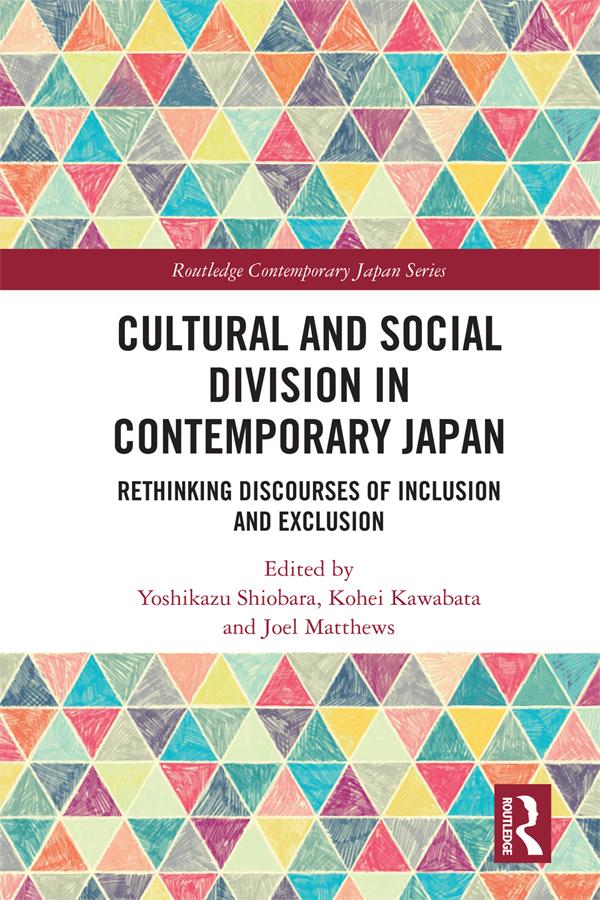
The recent manifestation of exclusionism in Japan has emerged at a time of intensified neoliberal economic policies, increased cross-border migration brought on by globalization, the elevated threat of global terrorism, heightened tensions between East Asian states over historical and territorial conflicts, and a backlash by Japanese conservatives over perceived historical apologism. The social and political environment for minorities in Japan has shifted drastically since the 1990s, yet many studies of Japan still tend to view Japan through the dominant discourses of “ethnic homogeneity (tanitsu minzoku shakai)” and “middle-class society (so¯churyu¯-shakai)” which positions the exclusion of minorities as an exceptional phenomenon. While exclusionism has been recognized as a serious threat to minority groups, it has not often been considered a representative issue for the whole of Japanese society. This tendency will persist until the discourses of tanitsu minzoku shakai and so¯churyu¯-shakai are systematically debunked and Japan is widely recognized as both multiethnic and socio-economically stratified.
Today, as with most advanced capitalist countries, serious social divides occasioned by the impacts of globalization and neoliberalism have destabilized Japanese society. This book explores not only how Japanese society is diversified and unequal, but also how diversity and inequality have caused people to divide into separate realities from which conflict and violence have emerged. It empirically examines the current situation while considering the historical development of exclusionism from the interdisciplinary viewpoints of history, policy studies, cultural studies, sociology and cultural anthropology. In addition to analyzing the realities of division and exclusionism, the authors propose theoretical alternatives to overcome such cultural and social divides.
Zahle einfach mit Karte, Klarna, Apple Pay oder Google Pay. Nicht zufrieden? Du hast immer ein 14-tägiges Widerrufsrecht. Lies mehr in unseren AGB. Hast du Fragen, schreib uns eine E-Mail an hello@memmo.org.
Memmo macht das Lernen einfacher – wo auch immer du bist. Bei uns findest du deine Kursbücher und smarte Lerntools an einem Ort: Zusammenfassungen, Quizzes, Podcasts und Lernkarten. Und Ted, dein Lernbuddy, beantwortet alles, was du wissen möchtest. Über 50.000 Studierende lernen bereits hier – gemacht, damit du schneller lernst und weniger Stress hast.