
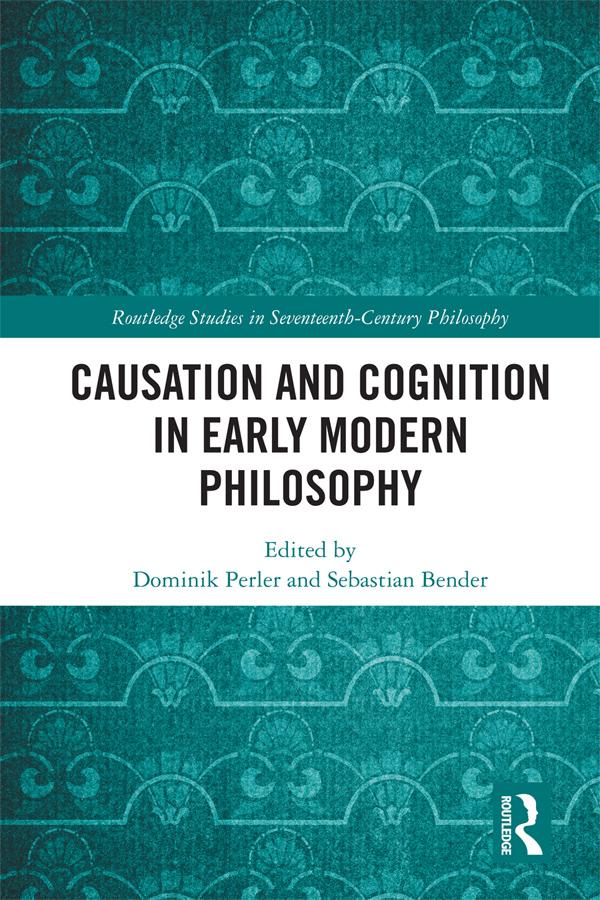
This book re-examines the roles of causation and cognition in early modern philosophy. The standard historical narrative suggests that early modern thinkers abandoned Aristotelian models of formal causation in favor of doctrines that appealed to relations of efficient causation between material objects and cognizers. This narrative has been criticized in recent scholarship from at least two directions. Scholars have emphasized that we should not think of the Aristotelian tradition in such monolithic terms, and that many early modern thinkers did not unequivocally reduce all causation to efficient causation.
In line with this general approach, this book features original essays written by leading experts in early modern philosophy. It is organized around five guiding questions:
- What are the entities involved in causal processes leading to cognition?
- What type(s) or kind(s) of causality are at stake? Are early modern thinkers confined to efficient causation or do other types of causation play a role?
- What is God's role in causal processes leading to cognition?
- How do cognitive causal processes relate to other, non-cognitive causal processes?
- Is the causal process in the case of human cognition in any way special? How does it relate to processes involved in the case of non-human cognition?
The essays explore how fifteen early modern thinkers answered these questions: Francisco Suárez, René Descartes, Louis de la Forge, Géraud de Cordemoy, Nicolas Malebranche, Thomas Hobbes, Baruch de Spinoza, Gottfried Wilhelm Leibniz, Ralph Cudworth, Margaret Cavendish, John Locke, John Sergeant, George Berkeley, David Hume, and Thomas Reid. The volume is unique in that it explores both well-known and understudied historical figures, and in that it emphasizes the intimate relationship between causation and cognition to open up new perspectives on early modern philosophy of mind and metaphysics.
Zahle einfach mit Karte, Klarna, Apple Pay oder Google Pay. Nicht zufrieden? Du hast immer ein 14-tägiges Widerrufsrecht. Lies mehr in unseren AGB. Hast du Fragen, schreib uns eine E-Mail an hello@memmo.org.
Memmo macht das Lernen einfacher – wo auch immer du bist. Bei uns findest du deine Kursbücher und smarte Lerntools an einem Ort: Zusammenfassungen, Quizzes, Podcasts und Lernkarten. Und Ted, dein Lernbuddy, beantwortet alles, was du wissen möchtest. Über 50.000 Studierende lernen bereits hier – gemacht, damit du schneller lernst und weniger Stress hast.