
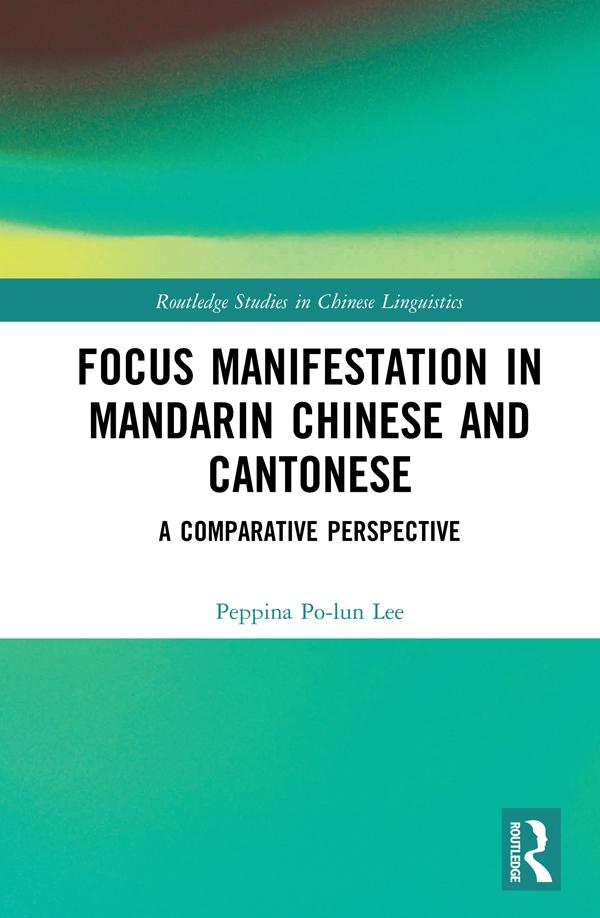
One prominent function of natural language is to convey information. One peculiarity is that it does not do so randomly, but in a structured way, with information structuring formally recognized to be a component of grammar. Among all information structuring notions, focus is one primitive needed to account for all phenomena.
Focus Manifestation in Mandarin Chinese and Cantonese: A Comparative Perspective aims to examine from a semantic perspective how syntactic structures and focus adverbs in Mandarin Chinese and semantic particles in Cantonese conspire to encode focus structures and determine focus manifestation in Chinese. With both as tonal languages, Mandarin Chinese and Cantonese manifest different morpho-syntactic configurations to mark focus. A general principle governing focus marking in Mandarin Chinese and Cantonese is given in the book, which aims to give a better understanding on the underlying principles the two used to mark additive and restrictive meanings, and related focus interpretations. Particular attention is also drawn to the co-occurrence of multiple forms of restrictive and additive particles in Cantonese, including adverbs, verbal suffixes and sentence-final particles. Linearity has shown to be an important parameter to determine how focus is structured in Cantonese.
This book is aimed at advanced graduate students, researchers and scholars working on Chinese linguistics, syntax and semantics, and comparative dialectal grammar.
Zahle einfach mit Karte, Klarna, Apple Pay oder Google Pay. Nicht zufrieden? Du hast immer ein 14-tägiges Widerrufsrecht. Lies mehr in unseren AGB. Hast du Fragen, schreib uns eine E-Mail an hello@memmo.org.
Memmo macht das Lernen einfacher – wo auch immer du bist. Bei uns findest du deine Kursbücher und smarte Lerntools an einem Ort: Zusammenfassungen, Quizzes, Podcasts und Lernkarten. Und Ted, dein Lernbuddy, beantwortet alles, was du wissen möchtest. Über 50.000 Studierende lernen bereits hier – gemacht, damit du schneller lernst und weniger Stress hast.