
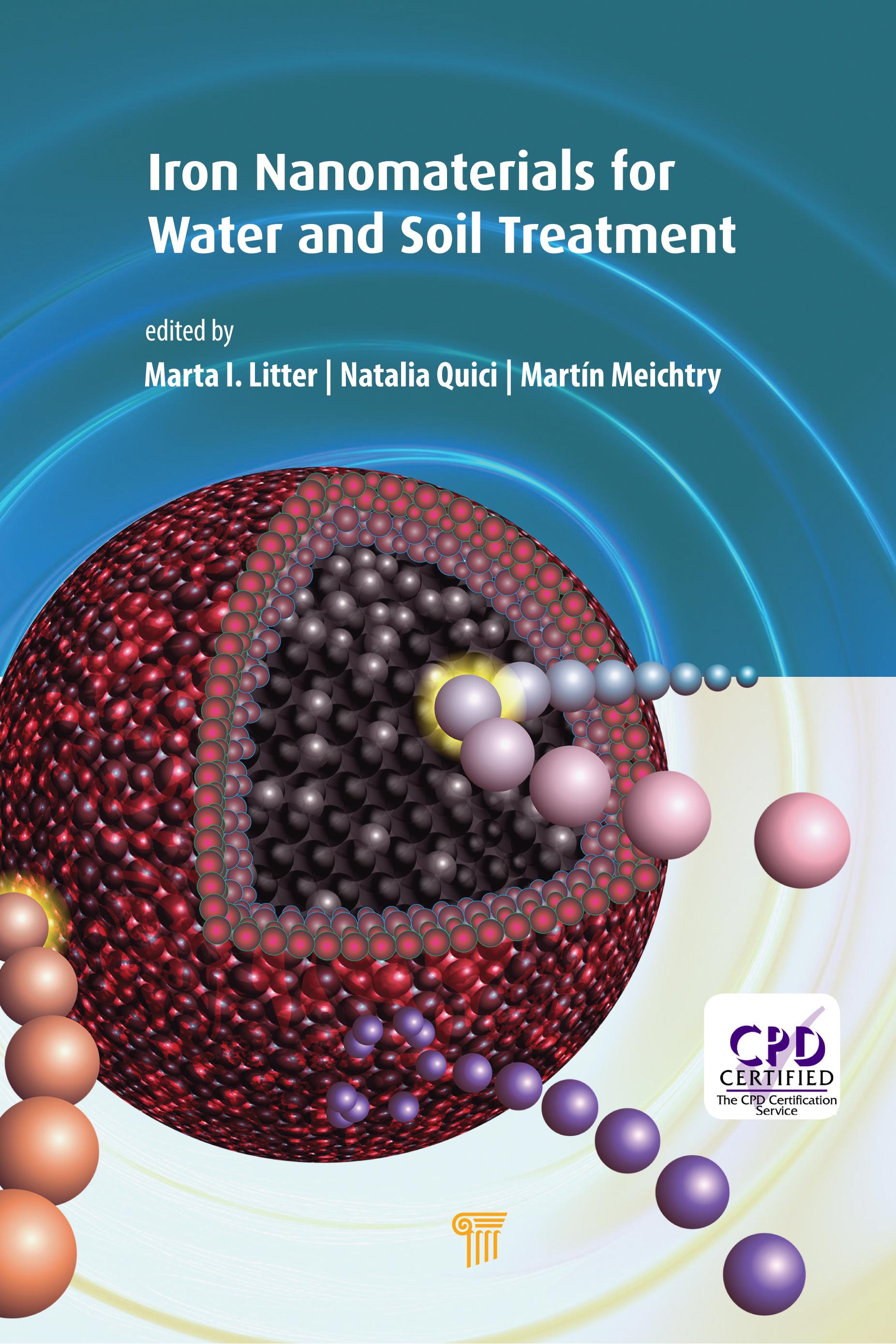
Nanotechnology has a great potential for providing efficient, cost-effective, and environmentally acceptable solutions to face the increasing requirements on quality and quantity of fresh water for industrial, agricultural, or human use. Iron nanomaterials, either zerovalent iron (nZVI) or iron oxides (nFeOx), present key physicochemical properties that make them particularly attractive as contaminant removal agents for water and soil cleaning. The large surface area of these nanoparticles imparts high sorption capacity to them, along with the ability to be functionalized for the enhancement of their affinity and selectivity. However, one of the most important properties is the outstanding capacity to act as redox-active materials, transforming the pollutants to less noxious chemical species by either oxidation or reduction, such as reduction of Cr(VI) to Cr(III) and dehalogenation of hydrocarbons.
This book focuses on the methods of preparation of iron nanomaterials that can carry out contaminant removal processes and the use of these nanoparticles for cleaning waters and soils. It carefully explains the different aspects of the synthesis and characterization of iron nanoparticles and methods to evaluate their ability to remove contaminants, along with practical deployment. It overviews the advantages and disadvantages of using iron-based nanomaterials and presents a vision for the future of this nanotechnology. While this is an easy-to-understand book for beginners, it provides the latest updates to experts of this field. It also opens a multidisciplinary scope for engineers, scientists, and undergraduate and postgraduate students.
Although there are a number of books published on the subject of nanomaterials, not too many of them are especially devoted to iron materials, which are rather of low cost, are nontoxic, and can be prepared easily and envisaged to be used in a large variety of applications. The literature has scarce reviews on preparation of iron nanoparticles from natural sources and lacks emphasis on the different processes, such as adsorption, redox pathways, and ionic exchange, taking place in the removal of different pollutants. Reports and mechanisms on soil treatment are not commonly found in the literature. This book opens a multidisciplinary scope for engineers and scientists and also for undergraduate or postgraduate students.
Zahle einfach mit Karte, Klarna, Apple Pay oder Google Pay. Nicht zufrieden? Du hast immer ein 14-tägiges Widerrufsrecht. Lies mehr in unseren AGB. Hast du Fragen, schreib uns eine E-Mail an hello@memmo.org.
Memmo macht das Lernen einfacher – wo auch immer du bist. Bei uns findest du deine Kursbücher und smarte Lerntools an einem Ort: Zusammenfassungen, Quizzes, Podcasts und Lernkarten. Und Ted, dein Lernbuddy, beantwortet alles, was du wissen möchtest. Über 50.000 Studierende lernen bereits hier – gemacht, damit du schneller lernst und weniger Stress hast.