
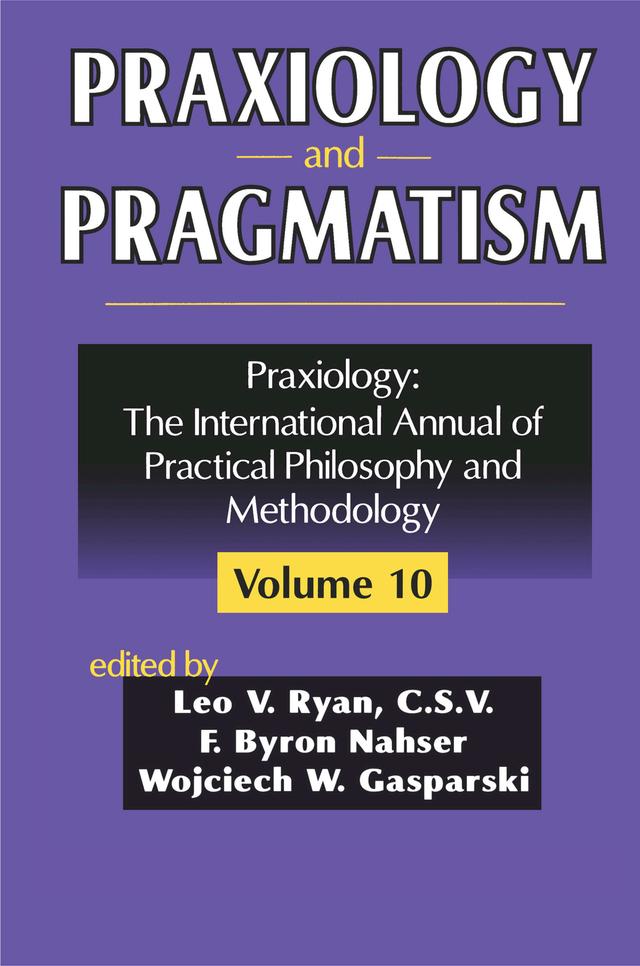
Volume l0 in this distinguished series addresses two distinct but interrelated philosophical movements, which exemplify different approaches to the study of ethics. Praxiology, an unique Central European philosophical movement, embraces the study of purposeful and conscious action and the elements essential to each action, act, and causative act. Pragmatism, an uniquely American philosophical movement, was founded by Charles S. Peirce and William James, and is based on the meaning of conceptions, defined in their practical bearings that guides actions and measures them by practical consequences of belief.
The chapters in this volume are grouped in a section on Praxiology and one on Pragmatism. Each section defines the historical origins of their respective philosophical movements, describes their methodology, and interrelates their impact on "human conduct" and contemporary society. The section on Praxiology presents for the first time in English a seminal study, "The ABC of Practicality," written in l972 by Tadeusz Kotarbinski, the father of modern Polish praxiology. Wojciech W. Gasparski offers an interpretative analysis of Praxiology. Daryl Koehn explores the nature of practical judgment and Timo Airaksinen applies praxiological efficiency in professional ethics.
The section devoted directly to Pragmatism includes scholarly contributions by eight academics on the relevance of pragmatism to management (Juan Fontrodona), business ethics (Sandra Rosenthal), law ( Fred Kellogg), and pragmatic inquiry (F. Byron Nahser). The contribution of Max Scheler to pragmatism (Manfred Frings) and the influence of William James on business ethics(Dennis McCann) are groundbreaking contributions to the study of pragmatism. The volume also includes a teaching model for a classroom application of pragmatism (Jack Ruhe), and concludes with an evaluation of the renaissance of interest in pragmatism in Europe (Jacek Sojka). Leo V. Ryan, C.S.V., professor of management, DePaul University, is past president of the Society for Business Ethics. He is co-editor of Human Action in Business (Vol. 5) and Business Students Focus on Ethics (Vol. 8) of the Praxiology series.
F. Byron Nahser is chairman and CEO, Globe Group, Chicago, the originator of Pathfinder Pragmatic Inquiry Method and author of Learning to Read the Signs: Reclaiming Pragmatism in Business.
Wojciech W. Gasparski is professor of humanities at the Institute of Philosophy and Sociology, the Polish Academy of Sciences, Warsaw, and editor-in-chief of the Praxiological series. He has published numerous volumes and over two hundred articles and conference papers.
Zahle einfach mit Karte, Klarna, Apple Pay oder Google Pay. Nicht zufrieden? Du hast immer ein 14-tägiges Widerrufsrecht. Lies mehr in unseren AGB. Hast du Fragen, schreib uns eine E-Mail an hello@memmo.org.
Memmo macht das Lernen einfacher – wo auch immer du bist. Bei uns findest du deine Kursbücher und smarte Lerntools an einem Ort: Zusammenfassungen, Quizzes, Podcasts und Lernkarten. Und Ted, dein Lernbuddy, beantwortet alles, was du wissen möchtest. Über 50.000 Studierende lernen bereits hier – gemacht, damit du schneller lernst und weniger Stress hast.