
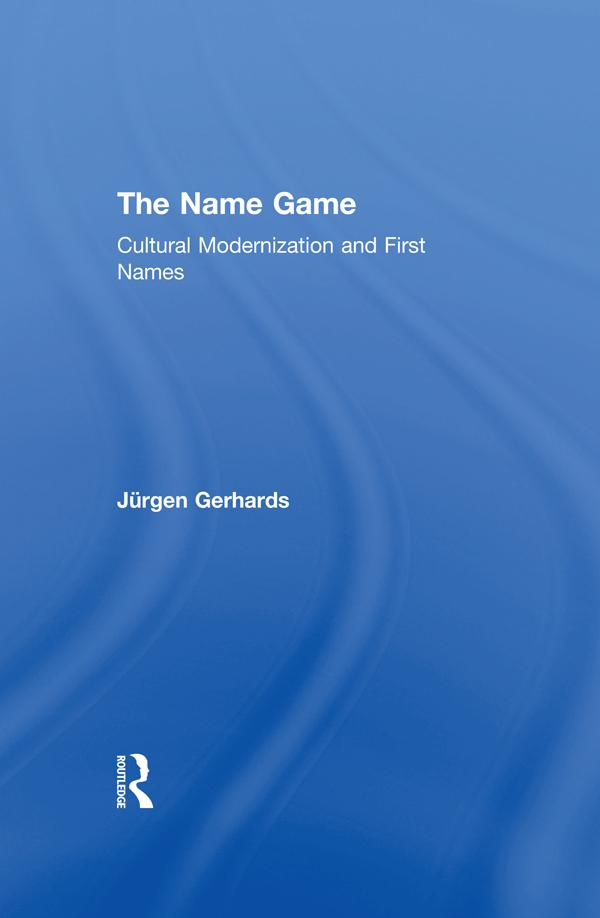
From decade to decade, significant changes occur in the choice of first names for children. One-time favorites are perceived as old fashioned and replaced by new choices. In The Name Game, Jurgen Gerhards shows that shifts in the choice of names are based on more than arbitrary trends of fashion. Instead, he demonstrates, they are determined by larger currents in cultural modernization. Using classic tools of sociology, Gerhards focuses on changing atterns of first names in Germany from the end of the nineteenth century to the end of the twentieth, using these as an indicator of cultural change. Among the influences he considers are religion, and he notes a trend toward greater secularization in first names. He considers the extent to which Christian names have been displaced, and whether the process is similar for Catholics and Protestants. He traces the impact of different political regimes (Second Empire, Weimar Republic, Third Reich, West Germany, East Germany) and the accompanying rise and fall of German nationalist sentiment. He also investigates the dissolution of the family as a unit of production, and its impact on the naming of children. He shows that the weakening of traditional ties of religion, nation, and family has led to greater individuation and greater receptivity toward foreign first names. Gerhards concludes with a discussion of whether the blurring of gender and sex roles is reflected in the decrease of gender-specific names. Written in a lucid, approachable style, The Name Game will be of interest not only to sociologists and cultural studies specialists, but also non-professionals, especially parents who are interested in reflecting on the process of name giving.
Zahle einfach mit Karte, Klarna, Apple Pay oder Google Pay. Nicht zufrieden? Du hast immer ein 14-tägiges Widerrufsrecht. Lies mehr in unseren AGB. Hast du Fragen, schreib uns eine E-Mail an hello@memmo.org.
Memmo macht das Lernen einfacher – wo auch immer du bist. Bei uns findest du deine Kursbücher und smarte Lerntools an einem Ort: Zusammenfassungen, Quizzes, Podcasts und Lernkarten. Und Ted, dein Lernbuddy, beantwortet alles, was du wissen möchtest. Über 50.000 Studierende lernen bereits hier – gemacht, damit du schneller lernst und weniger Stress hast.