
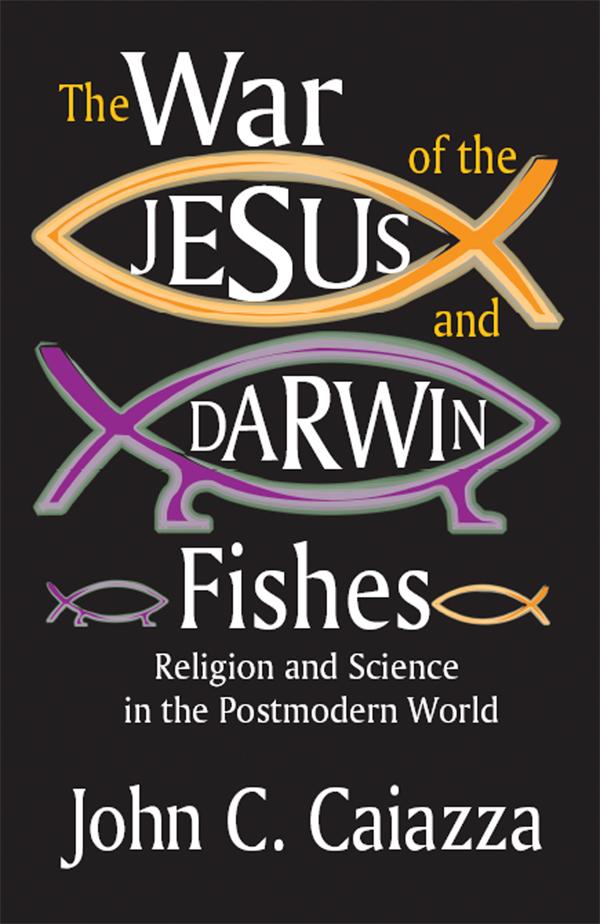
This volume's title stems from an observable and seemingly amusing phenomenon--the placement of fish symbols on the rear of automobiles. There are two kinds: one a fish outline with a cross, exhibited by Christians; the other a fish outline filled with the word "evolution," with little legs attached underneath. These symbols manifest the cultural war between religion and science, a clash that draws from nineteenth-century conflicts over evolution roots in the Enlightenment.
Today's cultural environment is a result of the internationalization of communication, labor, money, and commerce. This global culture emphasizes tolerance and acceptance of all peoples and traditions, but it also demands a moral and intellectual relativism that rejects "master narratives," including religious tradition as well as scientific theory. In some respects, the postmodern environment is caused by science itself, by the development of postmodern science, its nineteenth-century adversarial stance toward religion now somewhat softened. Among new developments are the historical understanding of science, renewed appreciation of the troubled careers of scientists, and "God" talk among physicists and psychologists. Both science and religion are being overwhelmed by new levels of technology, which is becoming the premier element of contemporary culture.
The conflict between science and religion is being resolved in the form of a dynamic. Religion and science are both ways of giving moral and intellectual order to the universe, enabling mankind to cope with a chaotic universe and live well. Both religious critics and scientific researchers have attacked and analyzed pornography, which has become a prominent characteristic of our culture. Both share contemporary sensitivity to individual opinions and protection of the individual from social control. Both science and religion share a sense that postmodern culture lacks structure. Caiazza shows how renewed attention to religious and scientific insights can resolve longstanding conflicts, providing postmodern society with a vision of tolerable order.
Zahle einfach mit Karte, Klarna, Apple Pay oder Google Pay. Nicht zufrieden? Du hast immer ein 14-tägiges Widerrufsrecht. Lies mehr in unseren AGB. Hast du Fragen, schreib uns eine E-Mail an hello@memmo.org.
Memmo macht das Lernen einfacher – wo auch immer du bist. Bei uns findest du deine Kursbücher und smarte Lerntools an einem Ort: Zusammenfassungen, Quizzes, Podcasts und Lernkarten. Und Ted, dein Lernbuddy, beantwortet alles, was du wissen möchtest. Über 50.000 Studierende lernen bereits hier – gemacht, damit du schneller lernst und weniger Stress hast.