
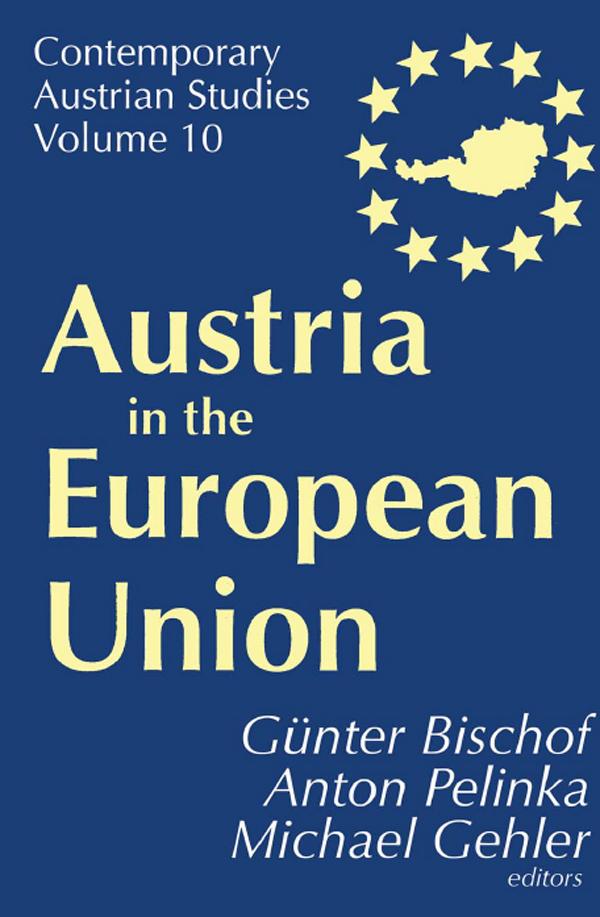
Austria joined the European Union in 1995, with the overwhelming support of its citizenry. In June 1994, a record 66.6 percent of the Austrian population voted in favor of joining the Union, and Austria acceded on January 1, 1995. Only three years later, in the second half of 1998, Austria assumed its first presidency of the European Union. Its competent conduct of the Union's business enhanced its reputation. The sense that Austria was a role model collapsed overnight, after a new conservative People's Party (iVP/FPi) coalition government was formed in Austria in early February 2000. Austria became Europe's nightmare.
This volume has two purposes. The first is to assess Austria's first five years in the European Union. The second is Austria's ongoing struggle with its past. Heinrich Neisser evaluates and assesses Austria's commitment to the European Union. Thomas Angerer offers a long-term perspective of regionalization and globalization trends in Austrian foreign affairs. Waldemar Hummer analyzes contradictions between Austrian neutrality and Europe's emerging common security policy. Johannes Pollak and Sonja Puntscher Rieckmann look at current debates over weighing future voting rights in the European Commission. Michael Huelshoff evaluates Austria's EU presidency in 1998 and compares it to the subsequent 1999 German presidency. Gerda Falkner examines the withering away of the previously much admired Austrian welfare state. Walter Manoschek scrutinizes the Nazi roots of Jorg Haider's Freedom Party. Michael Gehler critiques the EU sanctions and bemoans the absence of mediation through transnational Christian conservative parties.
In reviewing how Austria deals with World War II, Richard Mitten investigates discourses on victimhood in postwar Austria and the place of Jews in this process. A "Roundtable" presents overwhelming evidence of Austrians' deep involvement in Nazi war crimes, and includes articles by Sabine Loitfellner and Winfried Garscha. This addition to the Contemporary Austrian Studies series will be welcomed by political scientists, historians and legal scholars, particularly those with a strong interest in European affairs.
Zahle einfach mit Karte, Klarna, Apple Pay oder Google Pay. Nicht zufrieden? Du hast immer ein 14-tägiges Widerrufsrecht. Lies mehr in unseren AGB. Hast du Fragen, schreib uns eine E-Mail an hello@memmo.org.
Memmo macht das Lernen einfacher – wo auch immer du bist. Bei uns findest du deine Kursbücher und smarte Lerntools an einem Ort: Zusammenfassungen, Quizzes, Podcasts und Lernkarten. Und Ted, dein Lernbuddy, beantwortet alles, was du wissen möchtest. Über 50.000 Studierende lernen bereits hier – gemacht, damit du schneller lernst und weniger Stress hast.