
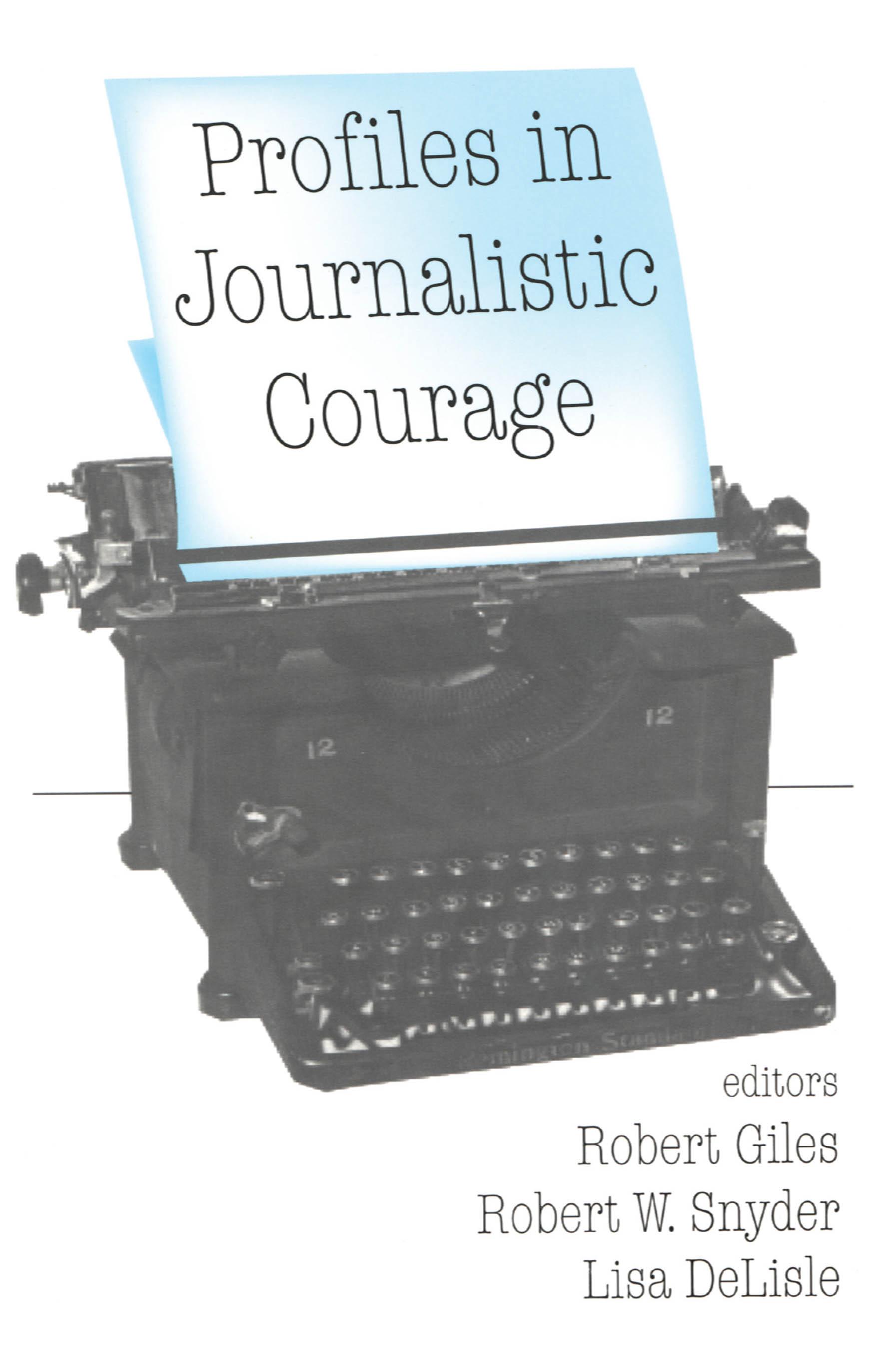
Some of the bravest actions of journalists are unknown, obscured by the passage of time, hidden by veils of anonymity or buried by systematic repression. Profiles in Journalistic Courage corrects this imbalance. With few exceptions, the stories told in this collection are unfamiliar. In the words of Richard Whelan on Robert Capa's vision of the Spanish Civil War, these tales are drawn from the edge of things. Most of the people highlighted here are journalists who worked on the margins of popularity, who blazed new and solitary paths, and who left fleeting legacies.Courageous journalists were not always thanked for their pioneering efforts. Jealousy, political disagreements, and differing conceptions of journalism sometimes fueled criticism of some of those dealt with in this volume. To complicate the subject further, brave journalists do not always act for reasons that win popularity or acclaim. Actions with laudable consequences are sometimes the result of egoism, stubbornness and ignorance, no less than selflessness, prudence, and principle. These psychological dimensions are not avoided in these profiles.In "Yesterday" David Copeland examines the tangled legacy of the trial of John Peter Zenger. Graham Hodges unearths the story of David Ruggles, an African-American journalist and abolitionist. Pamela Newkirk recalls the life and work of Ida B. Wells-Barnett. Pierre Albert explores the journalism of the French Resistance. Bernard L. Stein and Hank Klibanoff describe the work and motives of the civil rights movement. The volume covers the journalism of commitment from Northern Ireland to Native American tribes. It closes with an extended essay by James Boylan on varied perspectives on different aspects of courage in journalism, from the capacity to resist threats to the courage to tell people what they may not want to hear or read.
Zahle einfach mit Karte, Klarna, Apple Pay oder Google Pay. Nicht zufrieden? Du hast immer ein 14-tägiges Widerrufsrecht. Lies mehr in unseren AGB. Hast du Fragen, schreib uns eine E-Mail an hello@memmo.org.
Memmo macht das Lernen einfacher – wo auch immer du bist. Bei uns findest du deine Kursbücher und smarte Lerntools an einem Ort: Zusammenfassungen, Quizzes, Podcasts und Lernkarten. Und Ted, dein Lernbuddy, beantwortet alles, was du wissen möchtest. Über 50.000 Studierende lernen bereits hier – gemacht, damit du schneller lernst und weniger Stress hast.
Das könnte dir auch gefallen
Buch kaufen0