
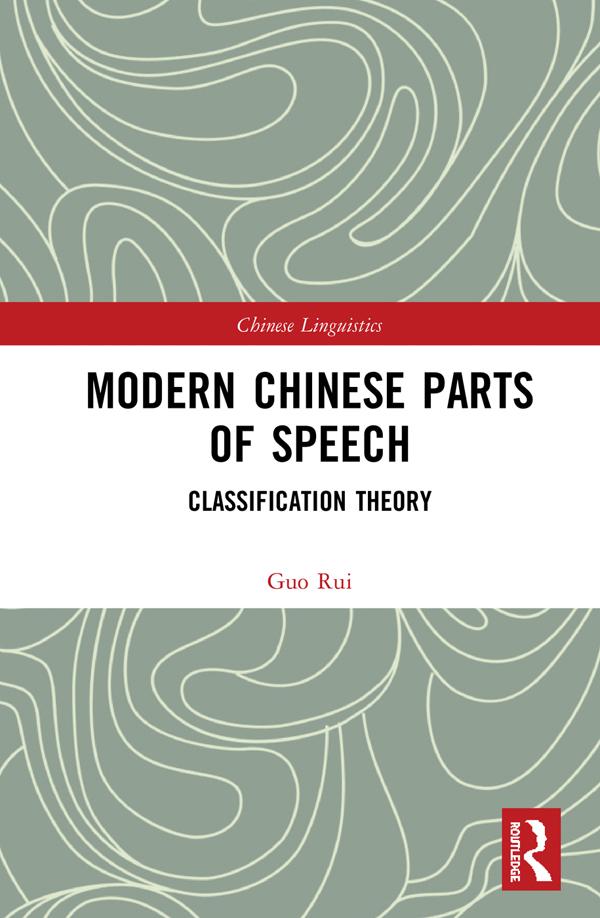
What is the essence of a part of speech? Why is it difficult to classify parts of speech? What are the bases and criteria for classifying them? How should they be classified? In doing so, how should a conversional word be dealt with? How should nomonalization be treated? These are just some of the questions answered in this book.
The classification of parts of speech in Chinese is a tough job due to the language's lack of morphological differences. Based on the analysis of nearly 40,000 Chinese characters, this book proposes that, essentially, a part of speech is not of distributional type and that its intrinsic basis is an expressional function and the semantic type. Essentially, large categories such as substantive words, predicate words and modification words are classes of words classified according to their expressional functions. Basic categories such as nouns, verbs and adjectives are classes that combine semantic types with syntactical functions. In classifying parts of speech, the book pays attention not to identifying a single distributive characteristic that is internally universal and externally exclusive but to clustering the grammatical functions that have the same classification value through the “reflection-representation” relationship among distribution, expressional function and semantic type (distribution reflects expressional function and semantic type, which are, in turn, represented as distribution), thereby identifying the classification criteria. It uses distributional compatibility and the correlation principle to analyze which distributional differences represent differences in parts of speech and which do not. In this way, grammatical functions that have equal classification values are collected into one equivalent function cluster, each of which represents one part of speech. The book uses four strategies to classify parts of speech, namely the homogeneity strategy, the homomorphical strategy, the priority homomorphical strategy and the consolidation strategy. It will be a valuable reference for Chinese linguistic researchers and students as well as Chinese learners.
Zahle einfach mit Karte, Klarna, Apple Pay oder Google Pay. Nicht zufrieden? Du hast immer ein 14-tägiges Widerrufsrecht. Lies mehr in unseren AGB. Hast du Fragen, schreib uns eine E-Mail an hello@memmo.org.
Memmo macht das Lernen einfacher – wo auch immer du bist. Bei uns findest du deine Kursbücher und smarte Lerntools an einem Ort: Zusammenfassungen, Quizzes, Podcasts und Lernkarten. Und Ted, dein Lernbuddy, beantwortet alles, was du wissen möchtest. Über 50.000 Studierende lernen bereits hier – gemacht, damit du schneller lernst und weniger Stress hast.