
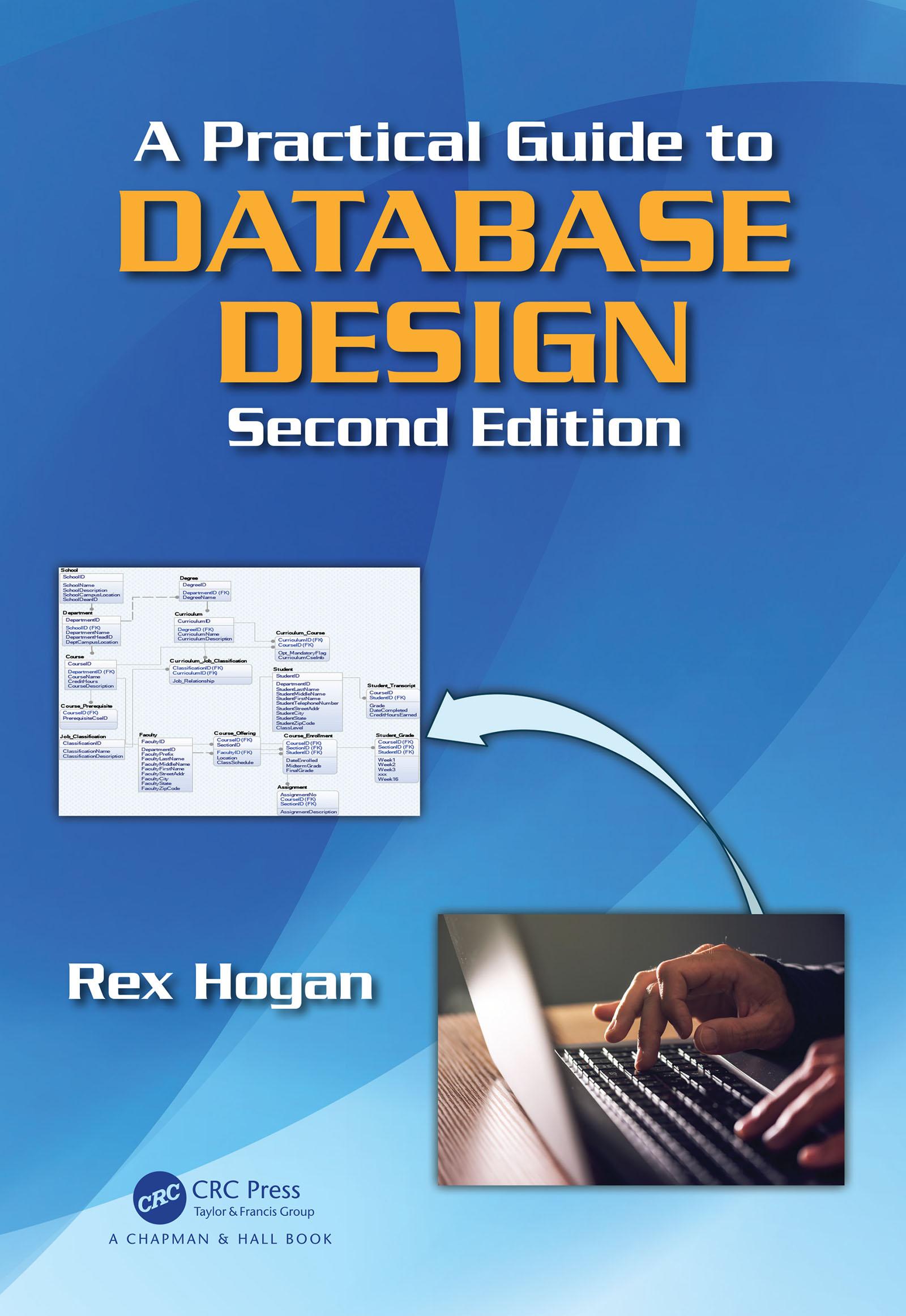
Fully updated and expanded from the previous edition, A Practical Guide to Database Design, Second Edition is intended for those involved in the design or development of a database system or application. It begins by illustrating how to develop a Third Normal Form data model where data is placed “where it belongs”. The reader is taken step-by-step through the Normalization process, first using a simple then a more complex set of data requirements. Next, usage analysis for each Logical Data Model is reviewed and a Physical Data Model is produced that will satisfy user performance requirements. Finally, each Physical Data Model is used as input to create databases using both Microsoft Access and SQL Server.
The book next shows how to use an industry-leading data modeling tool to define and manage logical and physical data models, and how to create Data Definition Language statements to create or update a database running in SQL Server, Oracle, or other type of DBMS.
One chapter is devoted to illustrating how Microsoft Access can be used to create user interfaces to review and update underlying tables in that database as well as tables residing in SQL Server or Oracle.
For users involved with Cyber activity or support, one chapter illustrates how to extract records of interest from a log file using PERL, then shows how to load these extracted records into one or more SQL Server “tracking” tables adding status flags for analysts to use when reviewing activity of interest. These status flags are used to flag/mark collected records as “Reviewed”, “Pending” (currently being analyzed) and “Resolved”. The last chapter then shows how to build a web-based GUI using PHP to query these tracking tables and allow an analyst to review new activity, flag items that need to be investigated, and finally flag items that have been investigated and resolved. Note that the book has complete code/scripts for both PERL and the PHP GUI.
Zahle einfach mit Karte, Klarna, Apple Pay oder Google Pay. Nicht zufrieden? Du hast immer ein 14-tägiges Widerrufsrecht. Lies mehr in unseren AGB. Hast du Fragen, schreib uns eine E-Mail an hello@memmo.org.
Memmo macht das Lernen einfacher – wo auch immer du bist. Bei uns findest du deine Kursbücher und smarte Lerntools an einem Ort: Zusammenfassungen, Quizzes, Podcasts und Lernkarten. Und Ted, dein Lernbuddy, beantwortet alles, was du wissen möchtest. Über 50.000 Studierende lernen bereits hier – gemacht, damit du schneller lernst und weniger Stress hast.