
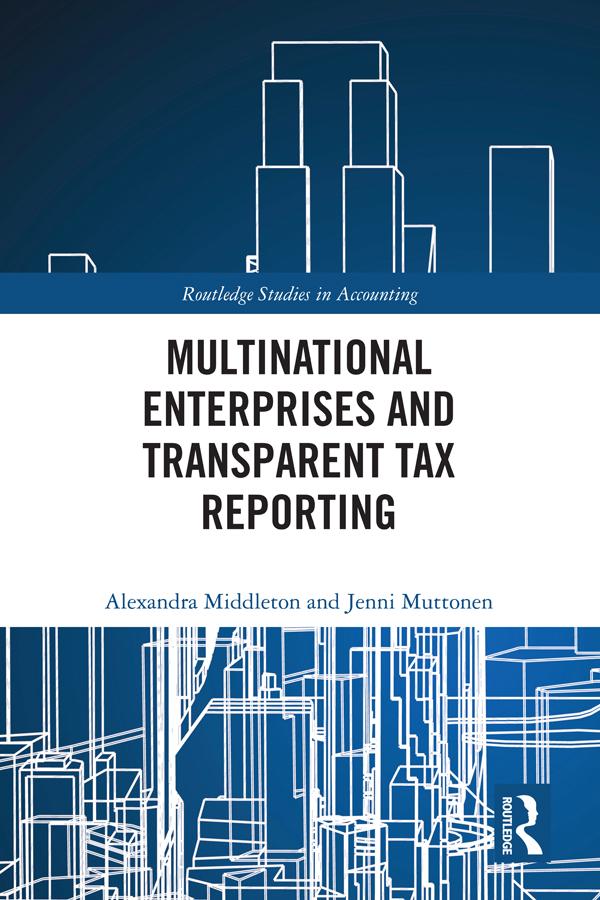
This book examines tax transparency as part of multinational enterprises’ corporate social responsibility (CSR). It considers revelations like the Panama and Paradise Papers that shed light on corporations’ tax practices and the growing public dissatisfaction, resulting in legislative projects, such as the Organisation for Economic Co-operation and Development (OECD) base erosion and profit shifting. Tax transparency is defined as companies’ voluntary disclosure of numerical tax data (e.g. taxes paid by country) and other tax-related information (e.g. tax policies). It is set apart from tax avoidance and tax evasion to clarify the often-blurred concepts.
In this book, tax transparency is placed in a historical context and possible drivers and hindering factors to tax transparency are investigated. Tax transparency is discussed in the light of socio-economic theories (stakeholder, legitimacy, institutional theory and reputation risk management), as well as economic theories (agency theory, signalling, proprietary costs) and information overload theory. The book provides examples of tax transparency development of the largest multinational enterprises in five countries (France, Germany, UK, Finland and USA) in six years, 2012–2017, a period featuring increased media coverage of tax matters and legislative movement in the OECD and the European Union. The future of tax transparency is discussed in light of quality characteristics, assurance of information and potential use of artificial intelligence.
Companies’ managers and tax and CSR specialists benefit from the book by gaining insight into how to design transparent, high-quality tax reporting. Assurance professionals can use information about the quality criteria of tax transparency. Regulators can track historical development and see examples of voluntary tax transparency in companies’ reporting. Scholars and students obtain theoretical framework for analysing the tax transparency phenomenon and the ability to distinguish between the concepts of tax transparency, planning, avoidance and evasion.
Zahle einfach mit Karte, Klarna, Apple Pay oder Google Pay. Nicht zufrieden? Du hast immer ein 14-tägiges Widerrufsrecht. Lies mehr in unseren AGB. Hast du Fragen, schreib uns eine E-Mail an hello@memmo.org.
Memmo macht das Lernen einfacher – wo auch immer du bist. Bei uns findest du deine Kursbücher und smarte Lerntools an einem Ort: Zusammenfassungen, Quizzes, Podcasts und Lernkarten. Und Ted, dein Lernbuddy, beantwortet alles, was du wissen möchtest. Über 50.000 Studierende lernen bereits hier – gemacht, damit du schneller lernst und weniger Stress hast.