
Consider this …
- How do we handle the convergence of landscape architecture, ecological planning, and civil engineering?
- What are convenient terms and metaphors to communicate the interplay between design and ecology?
- What are suitable scientific theories and technological means?
- What innovations arise from multidisciplinary and cross-scalar approaches?
- What are appropriate aesthetic statements and spatial concepts?
- What instruments and tools should be applied?
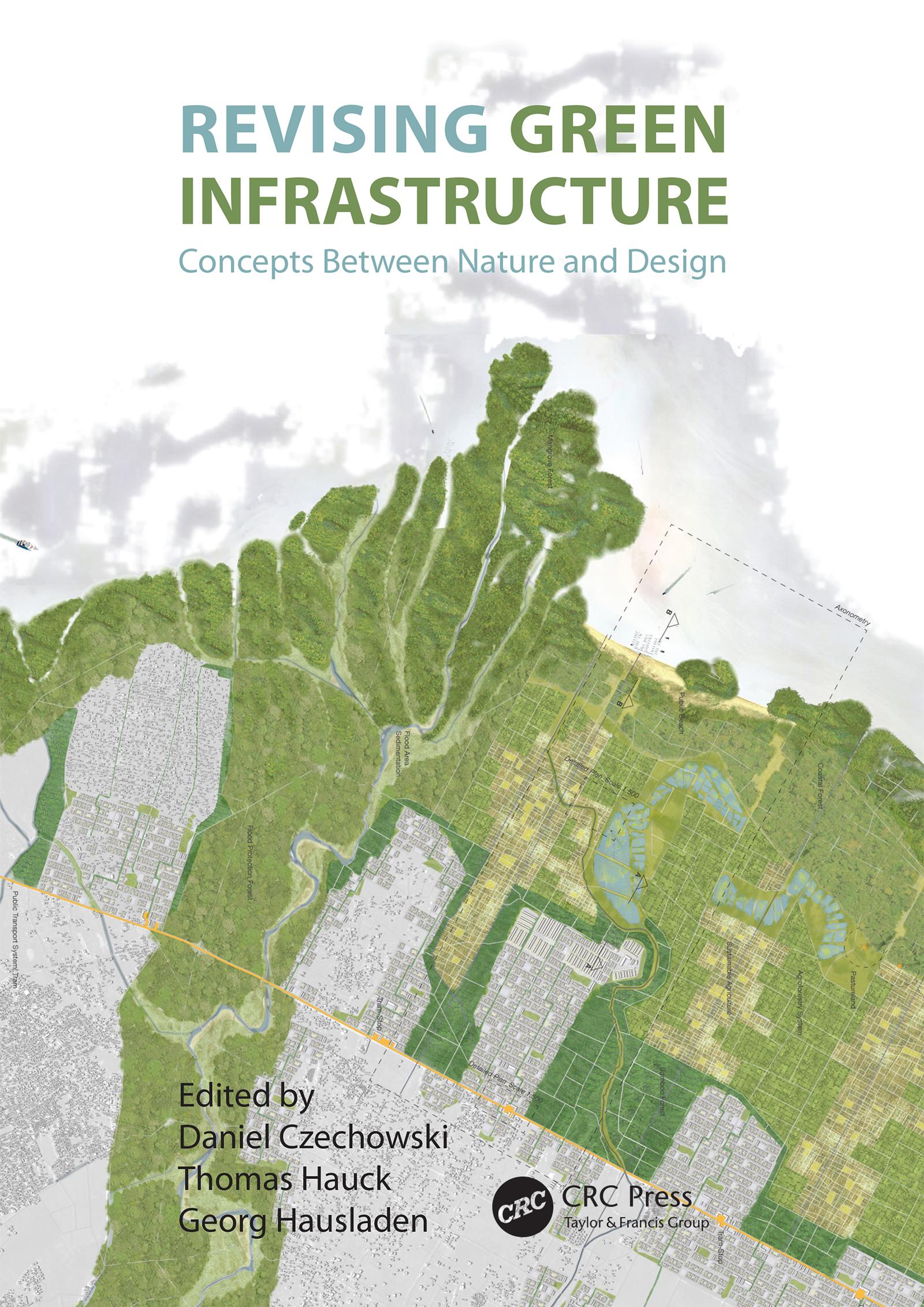
Revising Green Infrastructure: Concepts Between Nature and Design examines these questions and presents innovative approaches in designing green, landscape or nature as infrastructure from different perspectives and attitudes instead of adding another definition or category of green infrastructure. The editors bring together the work of selected ecologists, engineers, and landscape architects who discuss a variety of theoretical aspects, research projects, teaching methods, and best practice examples in green infrastructure. The approaches range from retrofitting existing infrastructures through landscape-based integrations of new infrastructures and envisioning prospective landscapes as hybrids, machines, or cultural extensions.
The book explores a scientific functional approach in landscape architecture. It begins with an overview of green functionalism and includes examples of how new design logics are deducted from ecology in order to meet economic and environmental requirements and open new aesthetic relationships toward nature. The contributors share a decidedly cultural perspective on nature as landscape. Their ecological view emphasizes the individual nature of specific local situations.
Building on this foundation, the subsequent chapters present political ideas and programs defining social relations toward nature and their integration in different planning systems as well as their impact on nature and society. They explore different ways of participation and cooperation within cities, regions, and nations. They then describe projects implemented in local contexts to solve concrete problems or remediate malfunctions. These projects illustrate the full scope presented and discussed throughout the book: the use of scientific knowledge, strategic thinking, communication with municipal authorities and local stakeholders, design implementation on site, and documentation and control of feedback and outcome with adequate indicators and metrics.
Although diverse and sometimes controversial, the discussion of how nature is regarded in contrast to society, how human-natural systems could be organized, and how nature could be changed, optimized, or designed raises the question of whether there is a new paradigm for the design of social relations to nature. The multidisciplinary review in this book brings together discussions previously held only within the respective disciplines, and demonstrates how they can be used to develop new methods and remediation strategies.
Zahle einfach mit Karte, Klarna, Apple Pay oder Google Pay. Nicht zufrieden? Du hast immer ein 14-tägiges Widerrufsrecht. Lies mehr in unseren AGB. Hast du Fragen, schreib uns eine E-Mail an hello@memmo.org.
Memmo macht das Lernen einfacher – wo auch immer du bist. Bei uns findest du deine Kursbücher und smarte Lerntools an einem Ort: Zusammenfassungen, Quizzes, Podcasts und Lernkarten. Und Ted, dein Lernbuddy, beantwortet alles, was du wissen möchtest. Über 50.000 Studierende lernen bereits hier – gemacht, damit du schneller lernst und weniger Stress hast.