
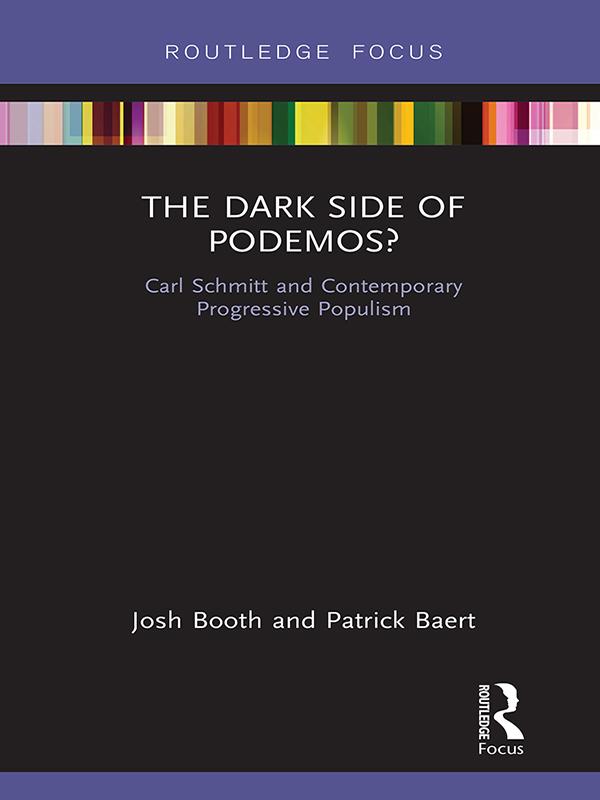
In 2014 a new progressive party, Podemos, emerged on the Spanish political scene. Within just over two years it had become the country’s third-biggest party, winning a slew of seats in parliament and regularly making headline news. While some see Podemos as the saviour of Spanish democracy, others have accused it of corrosive populism. But what few have noticed is that behind its distinctive rhetoric lies a thinker closely associated with Germany’s Third Reich: Carl Schmitt.
Why has an ostensibly progressive and avowedly anti-fascist political party taken up Schmitt’s ideas? The puzzle only deepens when we learn of Schmitt’s links with Francisco Franco’s dictatorship. In The Dark Side of Podemos?, Booth and Baert explain why Schmittian theory resonated with Podemos’ founders. In doing so, the authors position Podemos and the ideas that guide it within the context of recent Spanish history and ongoing politics of memory, revealing a story about how personal and political narratives have combined to produce a formidable political force.
This enlightening monograph will appeal to undergraduates and postgraduates, as well as postdoctoral researchers, interested in fields such as Politics, Political Theory and Sociology. It will also be relevant to those curious about contemporary Spanish politics, the nature of populism, the future of the European left, or Carl Schmitt and his links with Spain.
Zahle einfach mit Karte, Klarna, Apple Pay oder Google Pay. Nicht zufrieden? Du hast immer ein 14-tägiges Widerrufsrecht. Lies mehr in unseren AGB. Hast du Fragen, schreib uns eine E-Mail an hello@memmo.org.
Memmo macht das Lernen einfacher – wo auch immer du bist. Bei uns findest du deine Kursbücher und smarte Lerntools an einem Ort: Zusammenfassungen, Quizzes, Podcasts und Lernkarten. Und Ted, dein Lernbuddy, beantwortet alles, was du wissen möchtest. Über 50.000 Studierende lernen bereits hier – gemacht, damit du schneller lernst und weniger Stress hast.