
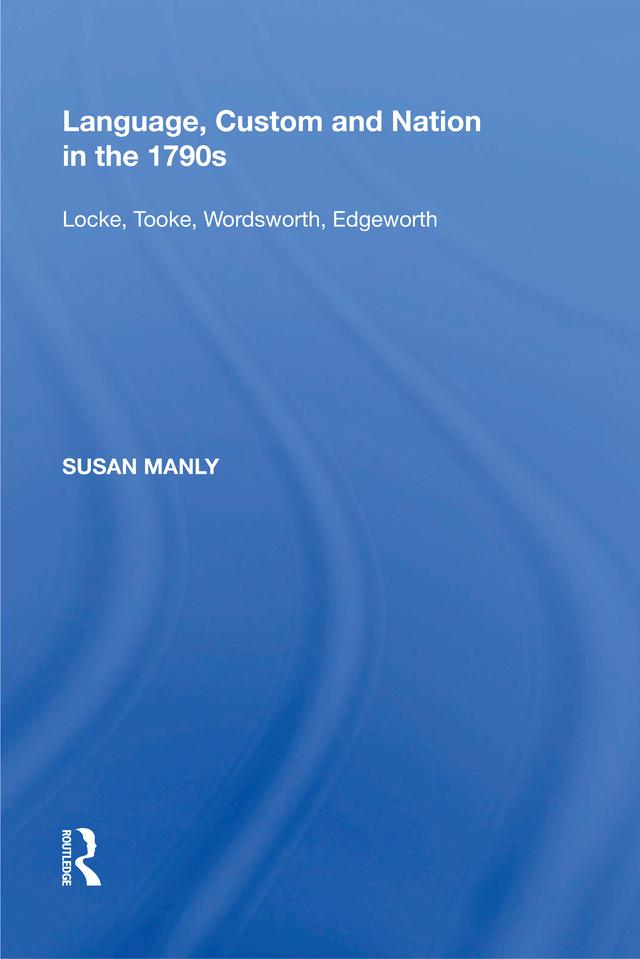
Language, Custom and Nation in the 1790s shows for the first time how the radical 'Jacobin' poets, and their ideas of a 'revolutionary' poetry, were impelled - even 'invented' - by the seventeenth-century English philosopher John Locke. For too long the revolutionary Romanticism and poetic experiments of the 1790s have been understood as responses to the American and French revolutions or attributed to the intellectual influence of Rousseau. The author counters these assumptions, by tracing threads of influence from Locke's ideas of 'arbitrary' language and tyranny, through Tooke's attacks on terms such as 'majesty' and 'law', to the supposedly 'real language' of Wordsworthian Romanticism. She breaks new ground in establishing Maria Edgeworth's place in Locke's anti-authoritarian tradition, contending that Edgeworth's work, produced in the shadow of the United Irishmen uprising, revives the politicisation of the idea of common language displaced in Wordsworth's neutralizing of Locke's radical impulse in the preface to Lyrical Ballads. The author's original and engaging book will appeal to scholars of 1790s radicalism, eighteenth-century linguistic theory, women's writing, and the relations between Britain and Ireland.
Zahle einfach mit Karte, Klarna, Apple Pay oder Google Pay. Nicht zufrieden? Du hast immer ein 14-tägiges Widerrufsrecht. Lies mehr in unseren AGB. Hast du Fragen, schreib uns eine E-Mail an hello@memmo.org.
Memmo macht das Lernen einfacher – wo auch immer du bist. Bei uns findest du deine Kursbücher und smarte Lerntools an einem Ort: Zusammenfassungen, Quizzes, Podcasts und Lernkarten. Und Ted, dein Lernbuddy, beantwortet alles, was du wissen möchtest. Über 50.000 Studierende lernen bereits hier – gemacht, damit du schneller lernst und weniger Stress hast.