
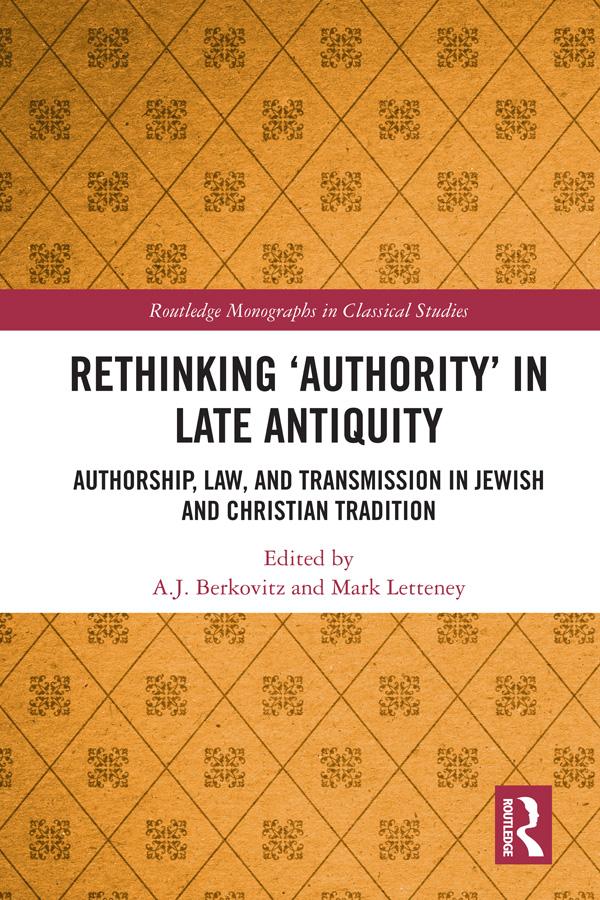
The historian’s task involves unmasking the systems of power that underlie our sources. A historian must not only analyze the content and context of ancient sources, but also the structures of power, authority, and political contingency that account for their transmission, preservation, and survival. But as a tool for interpreting antiquity, "authority" has a history of its own. As authority gained pride of place in the historiographical order of knowledge, other types of contingency have faded into the background. This book’s introduction traces the genesis and growth of the category, describing the lacuna that scholars seek to fill by framing texts through its lens. The subsequent chapters comprise case studies from late ancient Christian and Jewish sources, asking what lies "beyond authority" as a primary tool of analysis. Each uncovers facets of textual and social history that have been obscured by overreliance on authority as historical explanation. While chapters focus on late ancient topics, the methodological intervention speaks to the discipline of history as a whole. Scholars of classical antiquity and the early medieval world will find immediately analogous cases and applications. Furthermore, the critique of the place of authority as used by historians will find wider resonance across the academic study of history.
Zahle einfach mit Karte, Klarna, Apple Pay oder Google Pay. Nicht zufrieden? Du hast immer ein 14-tägiges Widerrufsrecht. Lies mehr in unseren AGB. Hast du Fragen, schreib uns eine E-Mail an hello@memmo.org.
Memmo macht das Lernen einfacher – wo auch immer du bist. Bei uns findest du deine Kursbücher und smarte Lerntools an einem Ort: Zusammenfassungen, Quizzes, Podcasts und Lernkarten. Und Ted, dein Lernbuddy, beantwortet alles, was du wissen möchtest. Über 50.000 Studierende lernen bereits hier – gemacht, damit du schneller lernst und weniger Stress hast.