
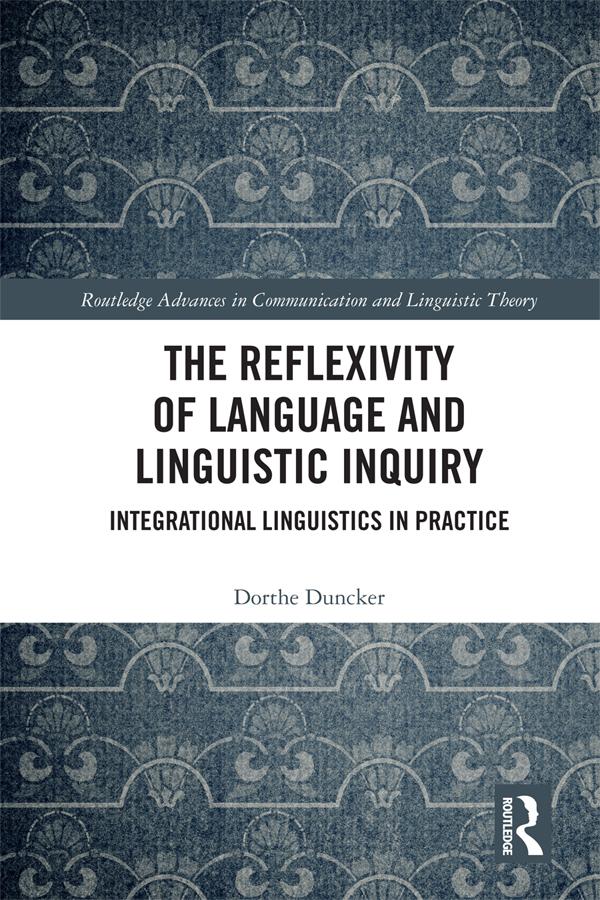
This book explores the reflexivity of language both from the perspective of the lay speaker and the linguistic analyst. Linguistic inquiry is conditional upon linguistic reflexivity, but so is language. Without linguistic reflexivity, we would not be able to make sense of everyday linguistic communication, and the idea of a language would not be conceivable. Not even fundamental notions such as words or meaning would exist. Linguistic reflexivity is a feature of the communication process, and it essentially depends on situated participants and time. It is a defining characteristic of the human language but despite its obvious importance, it is not very well understood theoretically, and it is strangely under-researched empirically. Throughout history and in modern linguistics, it has mostly either been taken for granted, misconstrued, or ignored. Only integrational linguistics fully recognizes its specifically linguistic implications. However, integrational linguistics does not provide the necessary methodological basis for investigating linguistic phenomena empirically. This catch-22 situation means that the goal of the book is twofold: one part is to explore the reflexivity of language theoretically, and the other part is to propose an applied integrational linguistics and to implement this proposal in practice.
Zahle einfach mit Karte, Klarna, Apple Pay oder Google Pay. Nicht zufrieden? Du hast immer ein 14-tägiges Widerrufsrecht. Lies mehr in unseren AGB. Hast du Fragen, schreib uns eine E-Mail an hello@memmo.org.
Memmo macht das Lernen einfacher – wo auch immer du bist. Bei uns findest du deine Kursbücher und smarte Lerntools an einem Ort: Zusammenfassungen, Quizzes, Podcasts und Lernkarten. Und Ted, dein Lernbuddy, beantwortet alles, was du wissen möchtest. Über 50.000 Studierende lernen bereits hier – gemacht, damit du schneller lernst und weniger Stress hast.