
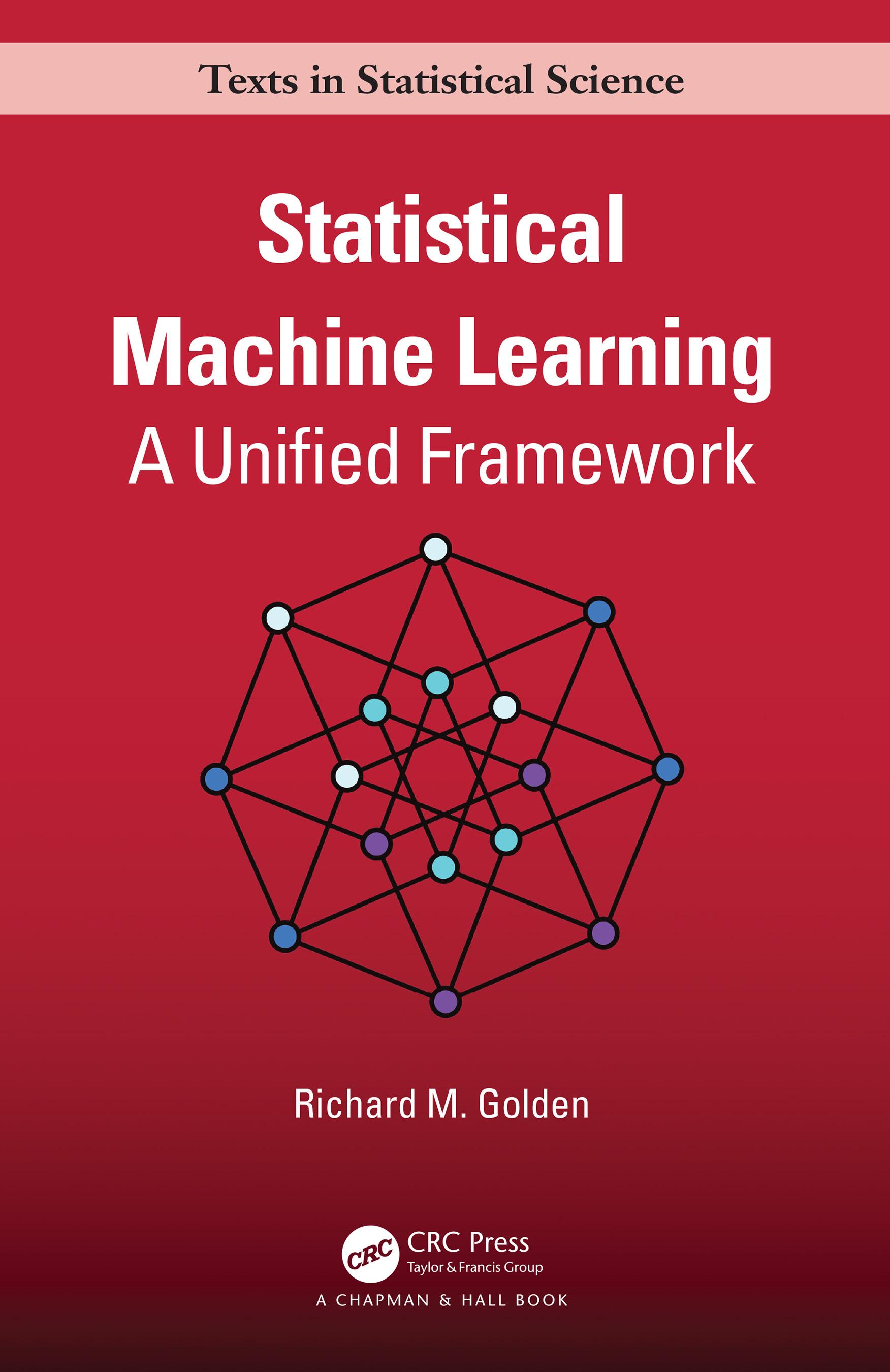
The recent rapid growth in the variety and complexity of new machine learning architectures requires the development of improved methods for designing, analyzing, evaluating, and communicating machine learning technologies. Statistical Machine Learning: A Unified Framework provides students, engineers, and scientists with tools from mathematical statistics and nonlinear optimization theory to become experts in the field of machine learning. In particular, the material in this text directly supports the mathematical analysis and design of old, new, and not-yet-invented nonlinear high-dimensional machine learning algorithms.
Features:
- Unified empirical risk minimization framework supports rigorous mathematical analyses of widely used supervised, unsupervised, and reinforcement machine learning algorithms
- Matrix calculus methods for supporting machine learning analysis and design applications
- Explicit conditions for ensuring convergence of adaptive, batch, minibatch, MCEM, and MCMC learning algorithms that minimize both unimodal and multimodal objective functions
- Explicit conditions for characterizing asymptotic properties of M-estimators and model selection criteria such as AIC and BIC in the presence of possible model misspecification
This advanced text is suitable for graduate students or highly motivated undergraduate students in statistics, computer science, electrical engineering, and applied mathematics. The text is self-contained and only assumes knowledge of lower-division linear algebra and upper-division probability theory. Students, professional engineers, and multidisciplinary scientists possessing these minimal prerequisites will find this text challenging yet accessible.
About the Author:
Richard M. Golden (Ph.D., M.S.E.E., B.S.E.E.) is Professor of Cognitive Science and Participating Faculty Member in Electrical Engineering at the University of Texas at Dallas. Dr. Golden has published articles and given talks at scientific conferences on a wide range of topics in the fields of both statistics and machine learning over the past three decades. His long-term research interests include identifying conditions for the convergence of deterministic and stochastic machine learning algorithms and investigating estimation and inference in the presence of possibly misspecified probability models.
Zahle einfach mit Karte, Klarna, Apple Pay oder Google Pay. Nicht zufrieden? Du hast immer ein 14-tägiges Widerrufsrecht. Lies mehr in unseren AGB. Hast du Fragen, schreib uns eine E-Mail an hello@memmo.org.
Memmo macht das Lernen einfacher – wo auch immer du bist. Bei uns findest du deine Kursbücher und smarte Lerntools an einem Ort: Zusammenfassungen, Quizzes, Podcasts und Lernkarten. Und Ted, dein Lernbuddy, beantwortet alles, was du wissen möchtest. Über 50.000 Studierende lernen bereits hier – gemacht, damit du schneller lernst und weniger Stress hast.