
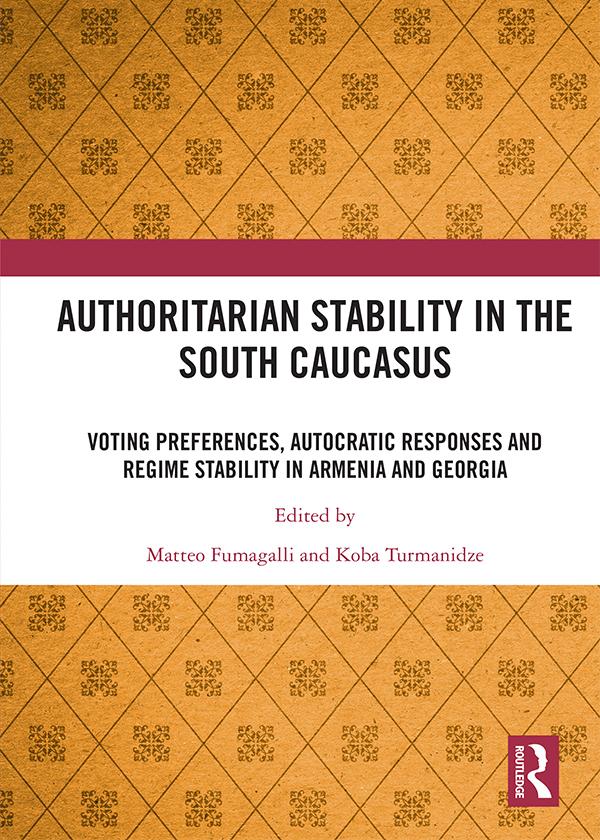
In recent years, competitive authoritarianism has become an increasingly common form of non-democratic politics. What is the relationship between the demand for particular public policies and a regime’s durability in office in such cases? How does policy-making interact with organizational power, the willingness to resort to coercion and patronage politics in countries home to democratic-looking institutions that none the less fall short of democratic standards?
In this book we show that such regimes do more than just survive and collapse. Moreover, we argue that far from being passive pawns in the hands of their leaders voters in competitive authoritarian regimes, do matter are taken seriously. We investigate how regimes and voters interact in the cases of Georgia and Armenia, two post-Soviet countries in the South Caucasus, to identify how voters preferences feed into policy-making and gauge the extent to which the regimes’ adjustment of their policies crucially affects regime stability. To these ends, we draw on a variety of quantitative and qualitative methods, including a survey experiment carried out in the two countries.
The volume was originally published as a special issue of the journal Caucasus Survey.
Zahle einfach mit Karte, Klarna, Apple Pay oder Google Pay. Nicht zufrieden? Du hast immer ein 14-tägiges Widerrufsrecht. Lies mehr in unseren AGB. Hast du Fragen, schreib uns eine E-Mail an hello@memmo.org.
Memmo macht das Lernen einfacher – wo auch immer du bist. Bei uns findest du deine Kursbücher und smarte Lerntools an einem Ort: Zusammenfassungen, Quizzes, Podcasts und Lernkarten. Und Ted, dein Lernbuddy, beantwortet alles, was du wissen möchtest. Über 50.000 Studierende lernen bereits hier – gemacht, damit du schneller lernst und weniger Stress hast.