
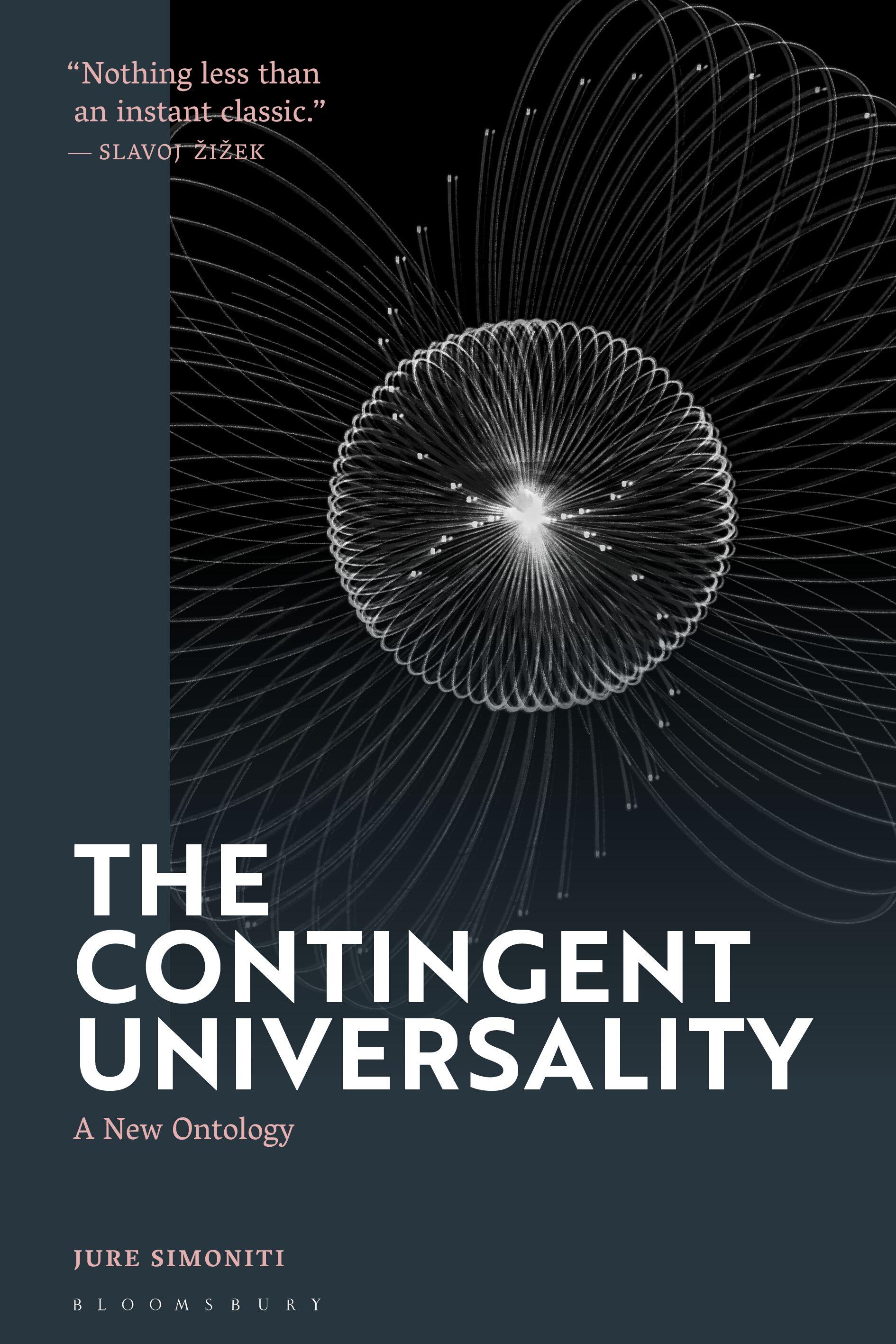
There may be such a thing as the most unbearable of all philosophical thoughts: the realization of the absolute contingency of the emergence of universals – and the correlative insight that the only true universality is the contingency of everything.
The entire history of philosophy can be seen as an endeavor to keep universality and contingency apart by setting up frameworks that promise to shield the sovereignty of truth from the fortuity of the current state of things. The Contingent Universality proposes a radical inversion. Under the sway of Platonism, we tend to associate contingency with the imperfect reign of particular things before our eyes, and universality with a more stable but remote order pulling the strings from afar. But what if it is the other way around? Could it be that we live in a world where no cosmic Law has ruled from the beginning of time, and that, for want of any Total Law, the only place left for universality to unfold is right here?
Tracing a sweeping intellectual arc from Plato through Kant and Hegel to the post-metaphysical thought of Kierkegaard, Nietzsche, Heidegger, and Wittgenstein, and building its case on the scientific revolutions from Copernicus onward, the book carries through an operation implicit in the philosophy of Slavoj Žižek. In doing so, it provides new answers to questions concerning the nature of contingency, necessity, the predictability of the future, the validity of the laws of nature, and the relation between singularity and universality, chaos and order, reality and truth.
The entire history of philosophy can be seen as an endeavor to keep universality and contingency apart by setting up frameworks that promise to shield the sovereignty of truth from the fortuity of the current state of things. The Contingent Universality proposes a radical inversion. Under the sway of Platonism, we tend to associate contingency with the imperfect reign of particular things before our eyes, and universality with a more stable but remote order pulling the strings from afar. But what if it is the other way around? Could it be that we live in a world where no cosmic Law has ruled from the beginning of time, and that, for want of any Total Law, the only place left for universality to unfold is right here?
Tracing a sweeping intellectual arc from Plato through Kant and Hegel to the post-metaphysical thought of Kierkegaard, Nietzsche, Heidegger, and Wittgenstein, and building its case on the scientific revolutions from Copernicus onward, the book carries through an operation implicit in the philosophy of Slavoj Žižek. In doing so, it provides new answers to questions concerning the nature of contingency, necessity, the predictability of the future, the validity of the laws of nature, and the relation between singularity and universality, chaos and order, reality and truth.
Zahle einfach mit Karte, Klarna, Apple Pay oder Google Pay. Nicht zufrieden? Du hast immer ein 14-tägiges Widerrufsrecht. Lies mehr in unseren AGB. Hast du Fragen, schreib uns eine E-Mail an hello@memmo.org.
Memmo macht das Lernen einfacher – wo auch immer du bist. Bei uns findest du deine Kursbücher und smarte Lerntools an einem Ort: Zusammenfassungen, Quizzes, Podcasts und Lernkarten. Und Ted, dein Lernbuddy, beantwortet alles, was du wissen möchtest. Über 50.000 Studierende lernen bereits hier – gemacht, damit du schneller lernst und weniger Stress hast.