
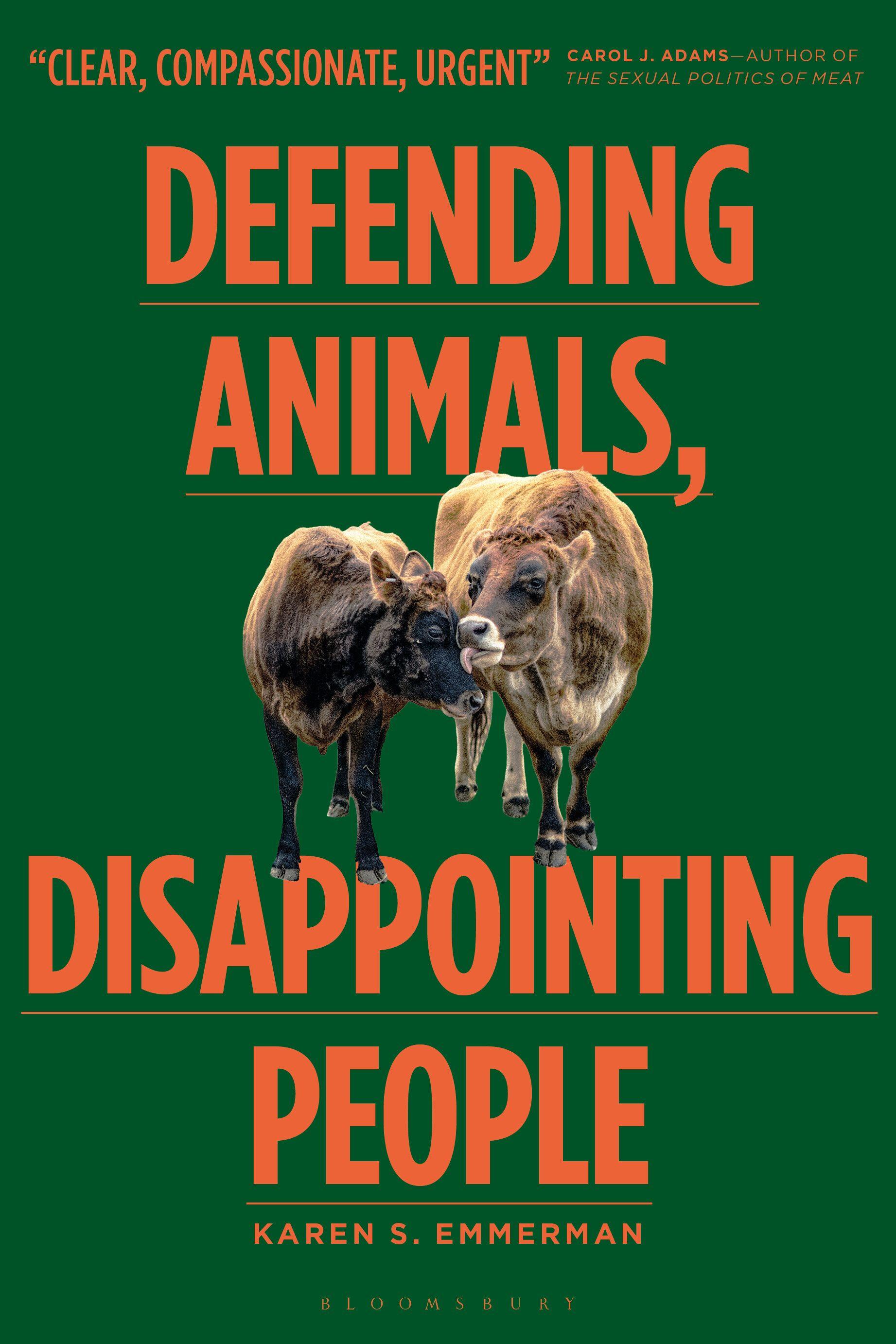
Defending Animals, Disappointing People offers a ground-breaking exploration of what happens when caring deeply about animals places us in conflict with the people we love.
Drawing on care ethics and relational philosophy, Karen S. Emmerman develops relational vegan ecofeminism, a framework that takes animals' moral standing seriously while also acknowledging the emotional, cultural, and familial stakes woven into human traditions. Rather than treating veganism as a simple matter of ethical prioritization, Emmerman shows that refusing a grandmother's lovingly prepared chicken soup, or rejecting a family hunting tradition, carries profound relational weight. These moments produce “moral remainders” of lingering hurt, regret, or estrangement that persists even when we make the best ethical choice.
Through richly contextual analysis, Emmerman argues that ethical life requires more than clear principles: it requires relational moral attention, a practice of empathy, repair, curiosity, and mutual recognition. Balancing philosophical rigor with narrative warmth, the book illuminates the tensions, grief, and possibilities at the heart of living ethically in a speciesist world. Defending Animals, Disappointing People sets out a hopeful yet honest path for navigating both inter-animal and intra-cultural conflicts – one that neither abandons animals nor dismisses the humans with whom we form our deepest connections.
Drawing on care ethics and relational philosophy, Karen S. Emmerman develops relational vegan ecofeminism, a framework that takes animals' moral standing seriously while also acknowledging the emotional, cultural, and familial stakes woven into human traditions. Rather than treating veganism as a simple matter of ethical prioritization, Emmerman shows that refusing a grandmother's lovingly prepared chicken soup, or rejecting a family hunting tradition, carries profound relational weight. These moments produce “moral remainders” of lingering hurt, regret, or estrangement that persists even when we make the best ethical choice.
Through richly contextual analysis, Emmerman argues that ethical life requires more than clear principles: it requires relational moral attention, a practice of empathy, repair, curiosity, and mutual recognition. Balancing philosophical rigor with narrative warmth, the book illuminates the tensions, grief, and possibilities at the heart of living ethically in a speciesist world. Defending Animals, Disappointing People sets out a hopeful yet honest path for navigating both inter-animal and intra-cultural conflicts – one that neither abandons animals nor dismisses the humans with whom we form our deepest connections.
Zahle einfach mit Karte, Klarna, Apple Pay oder Google Pay. Nicht zufrieden? Du hast immer ein 14-tägiges Widerrufsrecht. Lies mehr in unseren AGB. Hast du Fragen, schreib uns eine E-Mail an hello@memmo.org.
Memmo macht das Lernen einfacher – wo auch immer du bist. Bei uns findest du deine Kursbücher und smarte Lerntools an einem Ort: Zusammenfassungen, Quizzes, Podcasts und Lernkarten. Und Ted, dein Lernbuddy, beantwortet alles, was du wissen möchtest. Über 50.000 Studierende lernen bereits hier – gemacht, damit du schneller lernst und weniger Stress hast.