
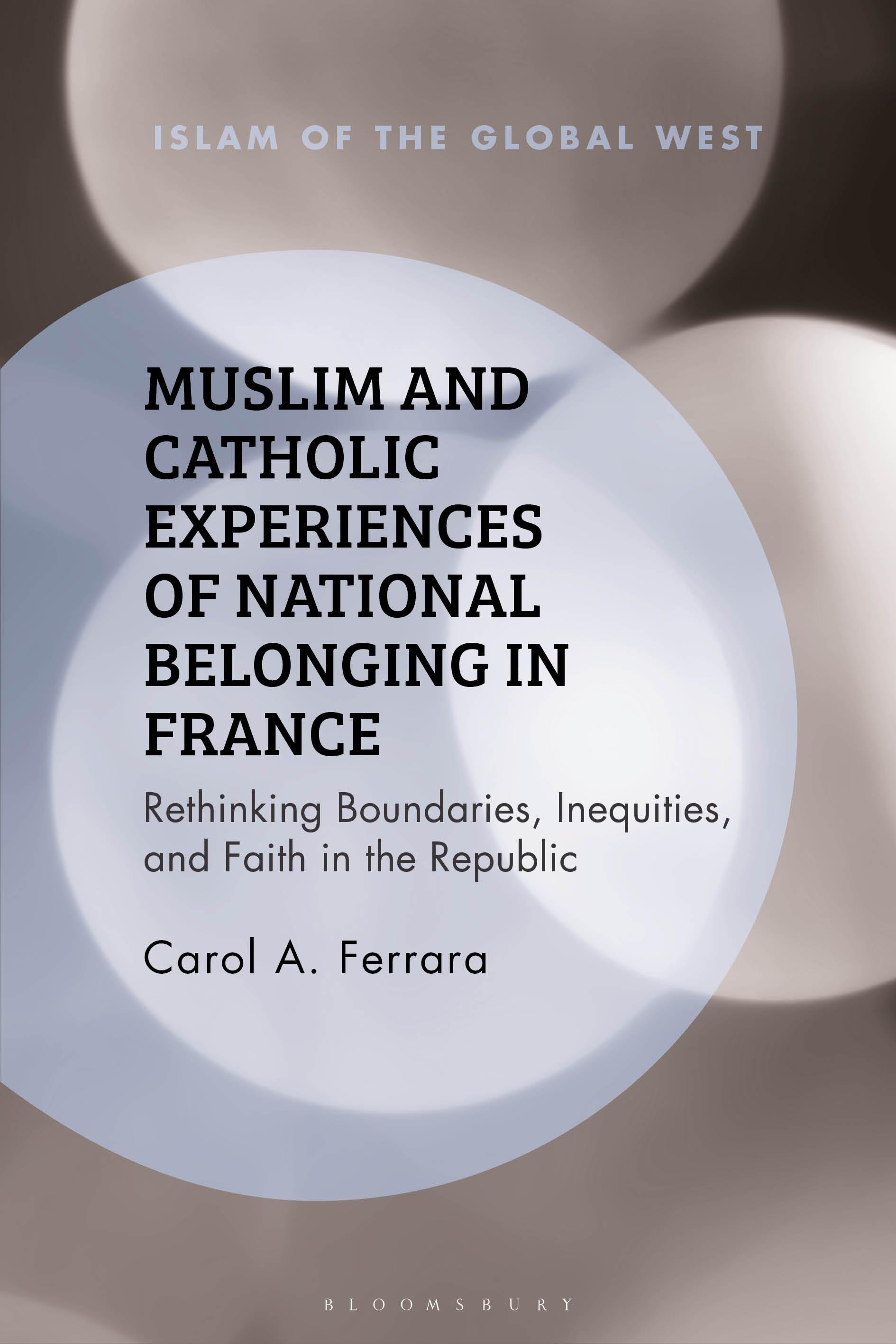
How do experiences of national identity and belonging differ for French Muslims and Catholics respectively? What can these differences tell us about the causes and dynamics of minority marginalization in plural secular societies?
To address these questions, Carol Ferrara draws upon extensive ethnographic fieldwork across France within spaces of religious education and interfaith dialogue, illustrating the inequities between Muslim and Catholic citizens in opportunities for national belonging, political and civic engagement, and institution-building. This reexamination of Muslim exclusion against the backdrop of Catholic inclusion calls into question popular explanations for minority marginalization – especially those that blame non-adherence to French Republican principles or the exclusionary power of secular discourse.
Instead, Ferrara argues that the boundaries of French belonging are policed by francité -a tacit national imaginary ideal-type that draws upon and reproduces national cognitive biases and undermines the French republican values of secularism, equality, liberty, and fraternity.
Given the central role of francité in the politics of belonging, Ferrara suggests that paths toward greater pluralism in France and beyond lie in the reframing of national identity narratives and reimagining the inclusive potential of secular democratic values.
To address these questions, Carol Ferrara draws upon extensive ethnographic fieldwork across France within spaces of religious education and interfaith dialogue, illustrating the inequities between Muslim and Catholic citizens in opportunities for national belonging, political and civic engagement, and institution-building. This reexamination of Muslim exclusion against the backdrop of Catholic inclusion calls into question popular explanations for minority marginalization – especially those that blame non-adherence to French Republican principles or the exclusionary power of secular discourse.
Instead, Ferrara argues that the boundaries of French belonging are policed by francité -a tacit national imaginary ideal-type that draws upon and reproduces national cognitive biases and undermines the French republican values of secularism, equality, liberty, and fraternity.
Given the central role of francité in the politics of belonging, Ferrara suggests that paths toward greater pluralism in France and beyond lie in the reframing of national identity narratives and reimagining the inclusive potential of secular democratic values.
Zahle einfach mit Karte, Klarna, Apple Pay oder Google Pay. Nicht zufrieden? Du hast immer ein 14-tägiges Widerrufsrecht. Lies mehr in unseren AGB. Hast du Fragen, schreib uns eine E-Mail an hello@memmo.org.
Memmo macht das Lernen einfacher – wo auch immer du bist. Bei uns findest du deine Kursbücher und smarte Lerntools an einem Ort: Zusammenfassungen, Quizzes, Podcasts und Lernkarten. Und Ted, dein Lernbuddy, beantwortet alles, was du wissen möchtest. Über 50.000 Studierende lernen bereits hier – gemacht, damit du schneller lernst und weniger Stress hast.