
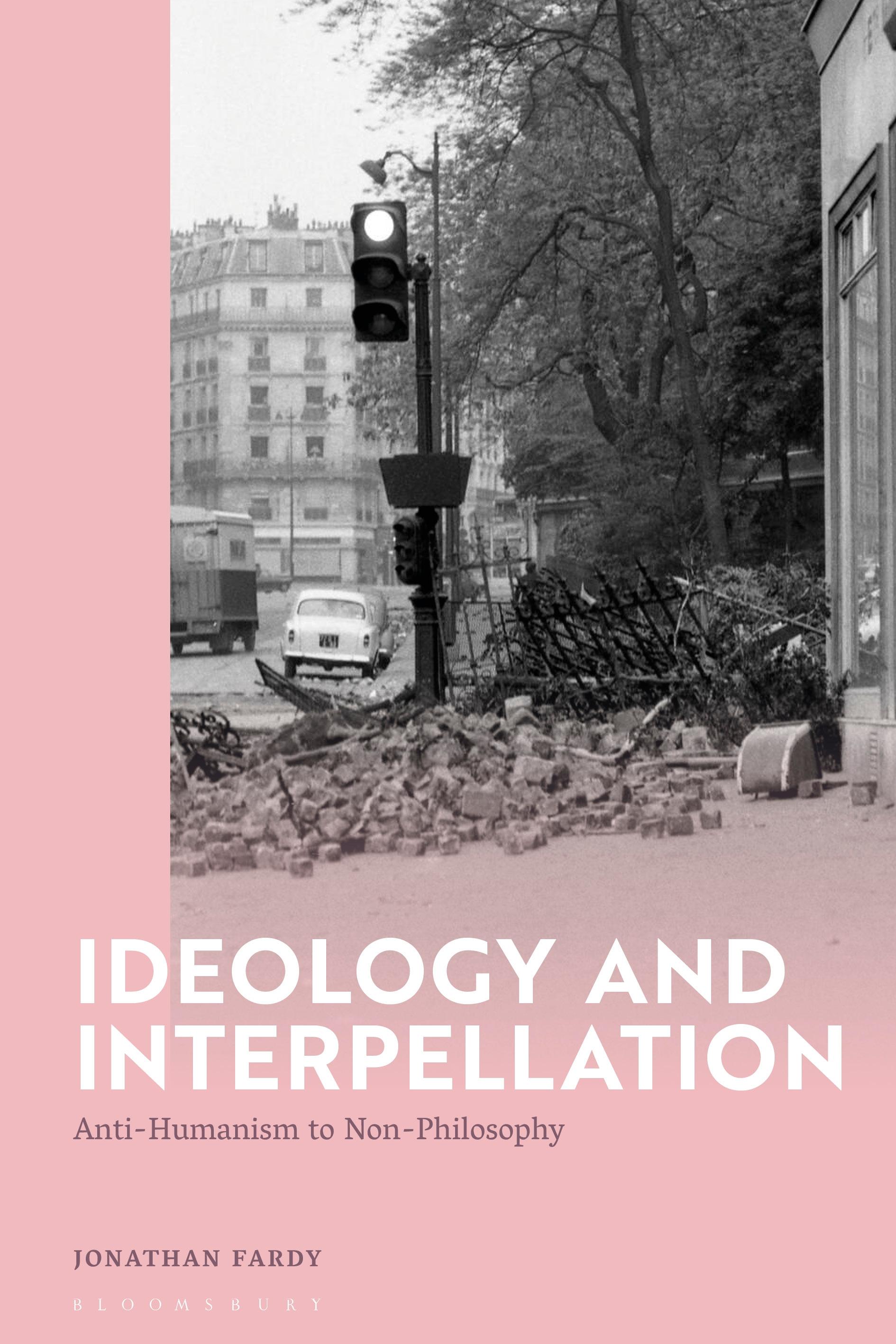
Ideology and Interpellation examines the relation between ideology, the humanist subject, interpellation, and the role of theory. Placing the work of Althusser, Rancière, Baudrillard, and Laruelle into dialogue, this book offers a useful starting point for understanding the demands and possibilities for ideological critique after the deconstruction of the subject.
With chapters devoted to each French theorist's critique, the book first examines the historical and political roots of Althusser's theory of ideology, then placing focus on Rancière's historiographic work in the following chapter. Coming hot on the heels of his blistering critique of his teacher, Althusser, in Althusser's Lesson, Rancière argues that reformers' failure to “interpellate” or recruit workers was due to their work-centric attitude and failure to understand the workers' dreams of lives devoted to unwaged aesthetic and philosophical labour. The fifth chapter shows how Baudrillard disrupts Althusser's fundamental belief that ideology can be unmasked to reveal true structures, by exposing how a society of simulation realizes the untrue by integrating it into the fabric of experience. Finally, Fardy explores how Laruelle calls into question Althusser's presumption that “standard philosophy” is sufficiently guarded against the lures of ideology. On the contrary, Laruelle suggests that this view is in fact that of the ideology of standard philosophy.
Shedding light on the continuing relevance of post-Althusserian Marxist thought, Ideology and Interpellation further demonstrates the need today for a rigorous theory of ideology, traces of which can be found in Althusser's legacy.
With chapters devoted to each French theorist's critique, the book first examines the historical and political roots of Althusser's theory of ideology, then placing focus on Rancière's historiographic work in the following chapter. Coming hot on the heels of his blistering critique of his teacher, Althusser, in Althusser's Lesson, Rancière argues that reformers' failure to “interpellate” or recruit workers was due to their work-centric attitude and failure to understand the workers' dreams of lives devoted to unwaged aesthetic and philosophical labour. The fifth chapter shows how Baudrillard disrupts Althusser's fundamental belief that ideology can be unmasked to reveal true structures, by exposing how a society of simulation realizes the untrue by integrating it into the fabric of experience. Finally, Fardy explores how Laruelle calls into question Althusser's presumption that “standard philosophy” is sufficiently guarded against the lures of ideology. On the contrary, Laruelle suggests that this view is in fact that of the ideology of standard philosophy.
Shedding light on the continuing relevance of post-Althusserian Marxist thought, Ideology and Interpellation further demonstrates the need today for a rigorous theory of ideology, traces of which can be found in Althusser's legacy.
Zahle einfach mit Karte, Klarna, Apple Pay oder Google Pay. Nicht zufrieden? Du hast immer ein 14-tägiges Widerrufsrecht. Lies mehr in unseren AGB. Hast du Fragen, schreib uns eine E-Mail an hello@memmo.org.
Memmo macht das Lernen einfacher – wo auch immer du bist. Bei uns findest du deine Kursbücher und smarte Lerntools an einem Ort: Zusammenfassungen, Quizzes, Podcasts und Lernkarten. Und Ted, dein Lernbuddy, beantwortet alles, was du wissen möchtest. Über 50.000 Studierende lernen bereits hier – gemacht, damit du schneller lernst und weniger Stress hast.