
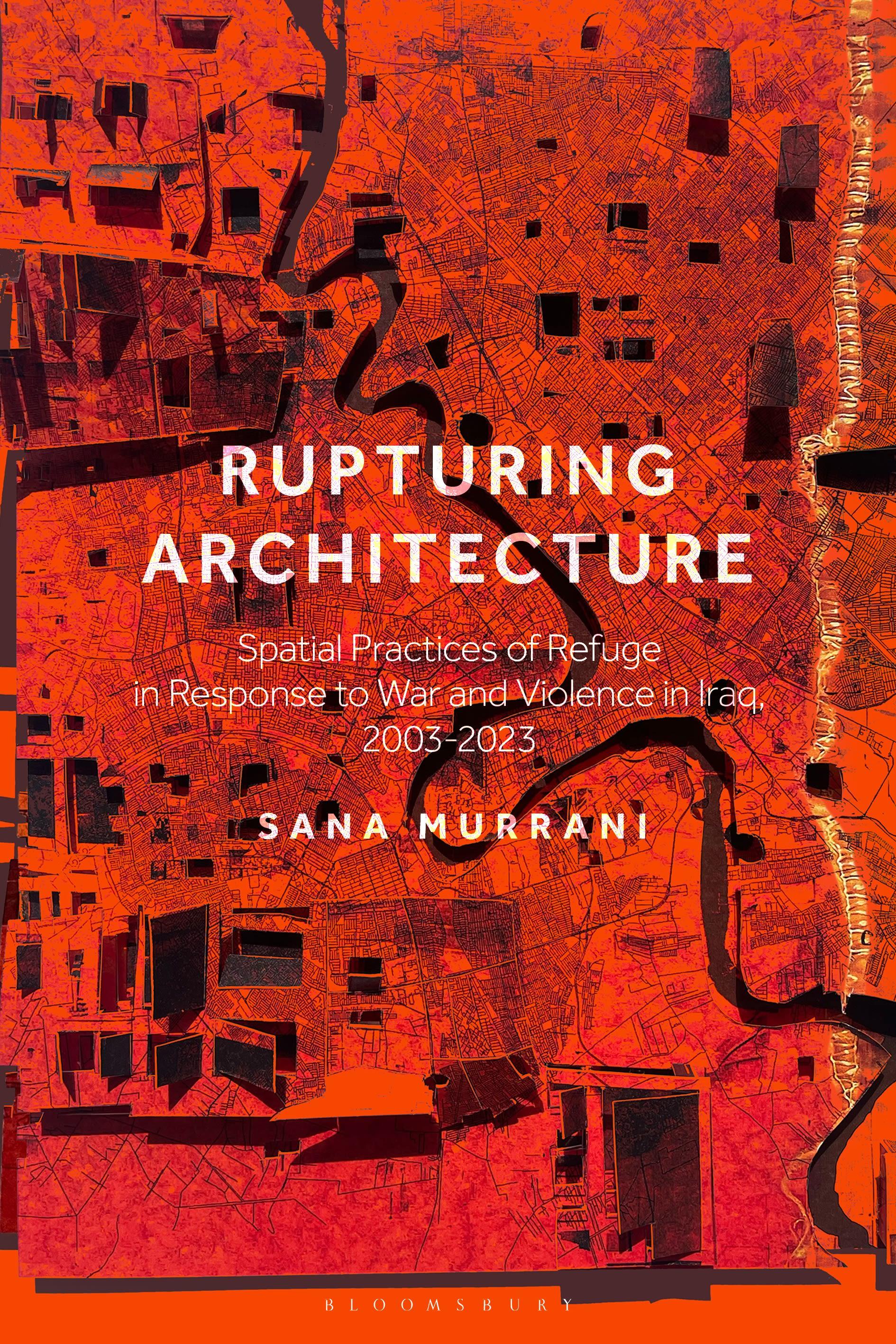
This is the first book to critically and visually explore the spatial practices of refuge in response to conditions of war, violence, and displacement experienced in Iraq from 2003 to 2023.
Written by an Iraqi architect who has lived through the trauma of several wars, 10 years of UN-imposed sanctions, an invasion, and the subsequent violence, this book captures a broad spectrum of spatial responses to trauma and presents a fresh perspective on how ordinary Iraqis create refuge across the spaces of the home, the urban environment, and border geographies.
In the face of spatial wounding and the many injustices suffered by the Iraqi people, there has also been a wealth of refuge-making practices that showcase their creative and imaginative design and adaptability to change and trauma over time. Rupturing Architecture employs methods such as creative deep mapping, memory work, storytelling, interviews, and case studies of architectural responses to the geographies of war and violence. At the core of the book are the lived and felt experiences of fifteen Iraqis from across Iraq, whose resilience underscores a broader narrative of spatial justice and feminist spatial practices. The book articulates the dual nature of rupturing as both a sign of trauma and a powerful act of resistance, examining how these forces shape domesticity, urbanity, and border spaces. The concluding manifesto for spatial justice calls for a deep, integrated understanding of place, memory, and trauma, advocating for comprehensive strategies in the making of refuge spaces that also resonate in a wider, global context.
Written by an Iraqi architect who has lived through the trauma of several wars, 10 years of UN-imposed sanctions, an invasion, and the subsequent violence, this book captures a broad spectrum of spatial responses to trauma and presents a fresh perspective on how ordinary Iraqis create refuge across the spaces of the home, the urban environment, and border geographies.
In the face of spatial wounding and the many injustices suffered by the Iraqi people, there has also been a wealth of refuge-making practices that showcase their creative and imaginative design and adaptability to change and trauma over time. Rupturing Architecture employs methods such as creative deep mapping, memory work, storytelling, interviews, and case studies of architectural responses to the geographies of war and violence. At the core of the book are the lived and felt experiences of fifteen Iraqis from across Iraq, whose resilience underscores a broader narrative of spatial justice and feminist spatial practices. The book articulates the dual nature of rupturing as both a sign of trauma and a powerful act of resistance, examining how these forces shape domesticity, urbanity, and border spaces. The concluding manifesto for spatial justice calls for a deep, integrated understanding of place, memory, and trauma, advocating for comprehensive strategies in the making of refuge spaces that also resonate in a wider, global context.
Zahle einfach mit Karte, Klarna, Apple Pay oder Google Pay. Nicht zufrieden? Du hast immer ein 14-tägiges Widerrufsrecht. Lies mehr in unseren AGB. Hast du Fragen, schreib uns eine E-Mail an hello@memmo.org.
Memmo macht das Lernen einfacher – wo auch immer du bist. Bei uns findest du deine Kursbücher und smarte Lerntools an einem Ort: Zusammenfassungen, Quizzes, Podcasts und Lernkarten. Und Ted, dein Lernbuddy, beantwortet alles, was du wissen möchtest. Über 50.000 Studierende lernen bereits hier – gemacht, damit du schneller lernst und weniger Stress hast.